Blog

  • Read Me This One: “Seahorse is Furious-and There’s Nothing You Can Do About It”

    “But everything in the ocean IS wet,” counters Sloane.

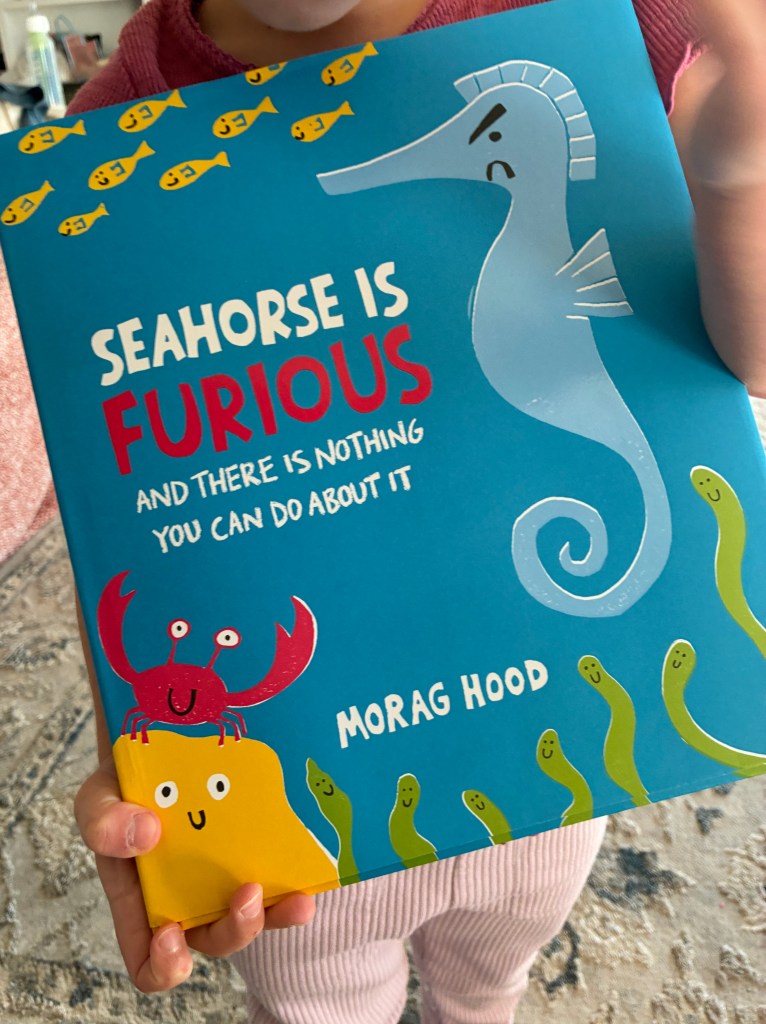
    We are reading “Seahorse Is Furious: (And There Is Nothing You Can Do About It)” by Morag Hood, and Seahorse is FURIOUS! He woke up wrong, stubbed his tail, and gotten tangled in the (ridiculous!) seaweeds. Now he complains that:

    His breakfast is wet.
    His tail is wet.
    His eyes are wet.
    Everything is wet!

    While Sloane is sympathetic, she is also learning to question the thinking of this particular character.
    “His breakfast is always wet,” she notes patiently, “’cause he lives in the ocean.”

    Summary


    There is high drama in the ocean.

    Today, Seahorse is grumpy.
    More than Grumpy.
    Seahorse is FURIOUS!

    Nothing is going to help, but that does not stop an octopus and his other ocean friends. They will try many different things to make Seahorse happy…including perfectly portioned sandwich slices, served on a beautiful green plate.

    Author/Illustrator

    Morag Hood is an author/illustrator of at least a dozen books for young children. She has won awards from the United Kingdom Literacy Association (UKLA) for her books Colin and Lee, Carrot and Pea, and I am Bat. She has also authored three books in the Sophie Johnson series.

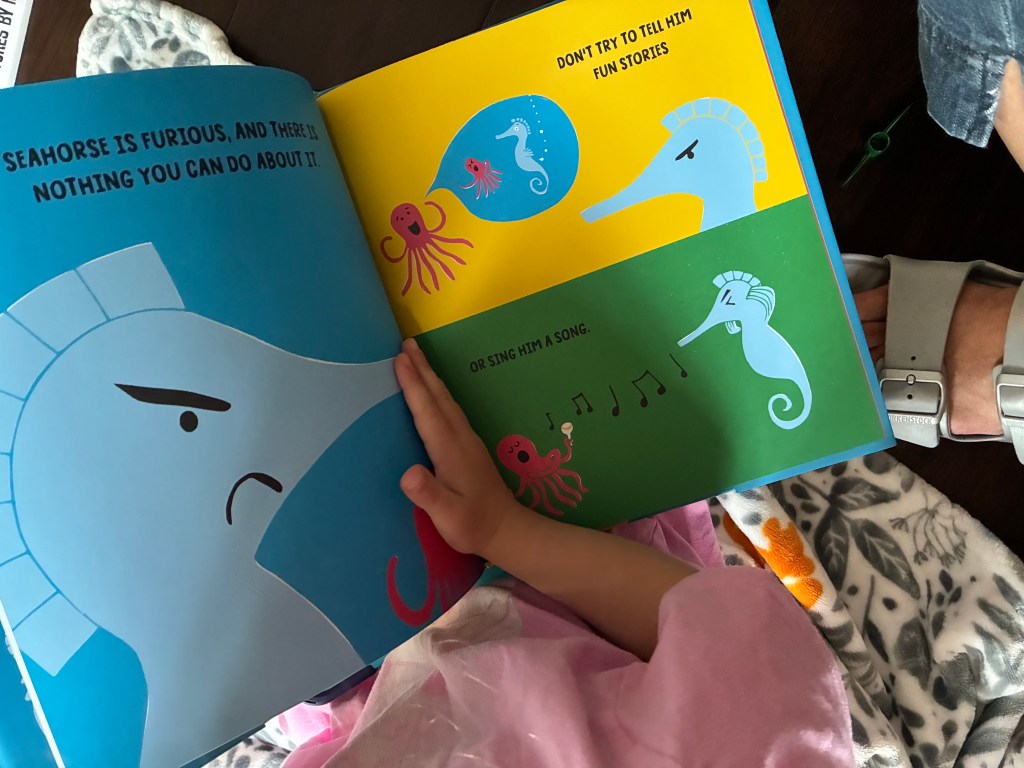
    Seahorse is Furious is an example of her artistic style. The primary colored illustrations float against a sea blue background. The seaweeds hugging Seahorse resemble undersea Matisse cut-outs. Octopus wears a sweet smile on domed head. Furious Seahorse uni-brow is knit in a permanent scowl.

    The text is in capital letters, with dramatic emphasis created in a larger font.
    Hood combines her simple drawings with a direct message; you cannot be furious forever when your friends are determined to help.

    Audience:

    The book is easy to read aloud and ideal for children ages 3-7.
    They understand big feelings and how hard it can be to be understood by others when those big feelings of frustration or anger or sadness become overwhelming.
    Additional Information

    There is plenty to smile about in Seahorse is Furious. Readers will find humor in Seahorse’s expressions and his dramatic crying.

    But there is a sophisticated kind of oppositional thinking as well. Readers do not always have to agree with a character. There is space in the story for reader interaction. A child can acknowledge Seahorse’s feelings while at the same time oppose his arguments to remain furious.

    This was most evident when Seahorse declared that “Hugs don’t help.”
    Meeting that challenge, Sloane softly responded,”Yes, they do.”
    She understood his feelings.
    She also understood the solution.
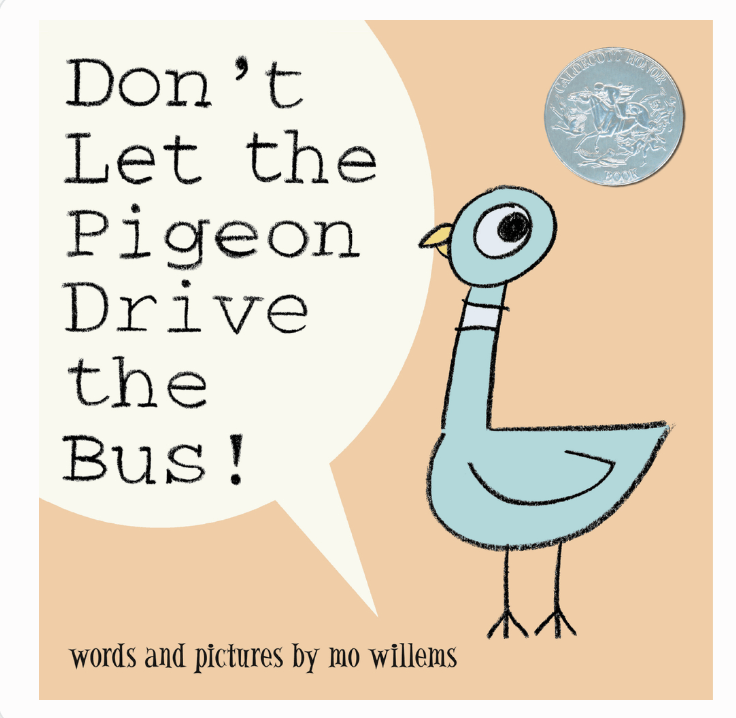


  • Read Me This Book: “Don’t Let the Pigeon Drive the Bus”

    David loves saying “No!”

    “NO” to a vegetable.
    “NO” to bedtime.
    “NO” to sharing.

    But I do encourage him to say “NO” everytime I turn a page in the book Don’t Let the Pigeon Drive the Bus”.

    BOOK SUMMARY

    A bus driver introduces himself, and then asks the reader for help.
    “Remember,” he says, “Don’t let the pigeon drive the bus, OK?”

    As soon as the bus driver is off the page, a Pigeon pops up and begins to ask repeatedly if he can drive the bus.
    What follows are hilarious stages in a primary school, Kubler-Ross-like meltdown:
    -the Pigeon tries to bargain,
    -the Pigeon tries guilt,
    -the Pigeon begs for fairness,
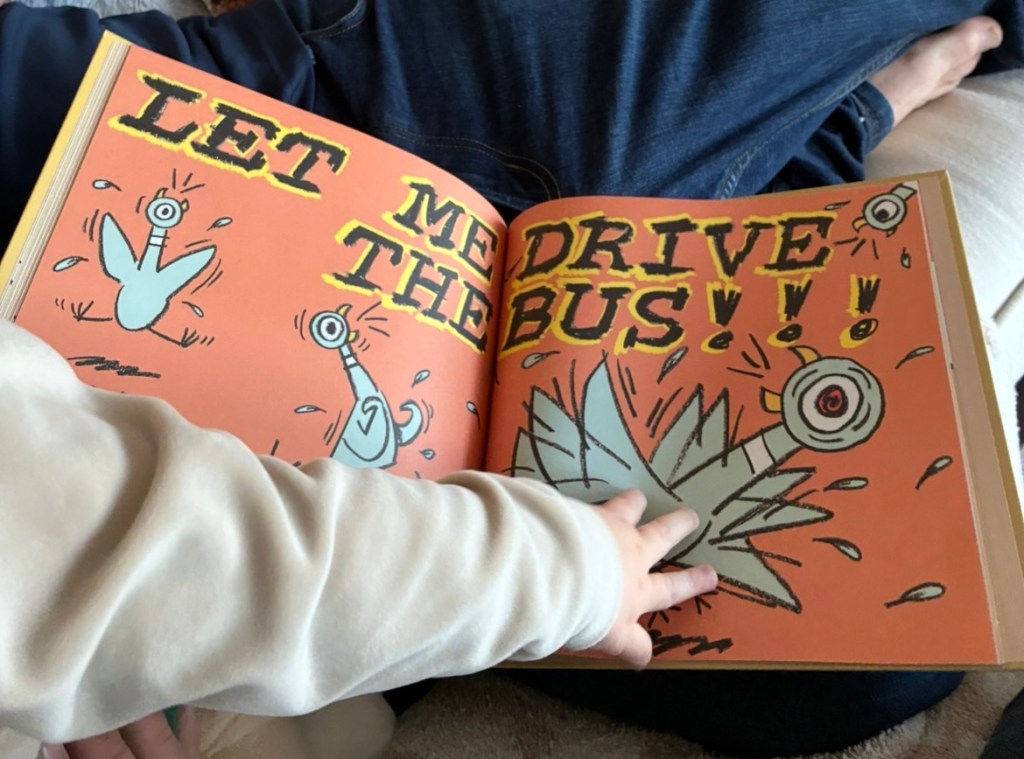
    -and in an epic two-page tantrum, the Pigeon shows ANGER!

    (NOTE: This is my David’s favorite page)

    AUTHOR/ILLUSTRATOR


    Mo Willems is a legend in the Picture Book Universe….a Pied Piper, a myth-maker, an American Hans Christian Andersen (without being grim).

    He is a children’s book   author/illustrator (over 70 books), an animator, and a voice actor with his origins beginning in Sesame Street (winning six Emmy’s for his writing).

    Several of his books have received Caldecott Honors: Don’t Let the Pigeon Drive the Bus!   (2004), Knuffle Bunny: A Cautionary Tale   (2005) and Knuffle Bunny Too: A Case of Mistaken Identity    (2008)

    His website (Hidden Pigeon Company) includes links to the Pigeon and Knuffle-Bunny series animations and read aloud recordings as well as links to his other book series (Elephant and Piggie, Unlimited Squirrel, Cat the Cat).

    During Covid (2020), Willems was the Kennedy Center Education Artist-in-Residence. He kept students engaged with his Lunch Doodles.

    He recently gave the Commencement Address at Colby College where he read aloud his book “Me”. (Listen carefully to hear a child echo the lines of the story as Willems reads!)

    IDEAL AUDIENCE

    The suggested ages are 2-5 years, but this and the other Pigeon books can be enjoyed by all ages.
    The interactive nature of “Don’t Let the Pigeon Drive the Bus” makes it great fun as a read-aloud with toddlers. After all, book is designed as a conversation:
    -the bus driver asking for help,
    -the Pigeon asking the reader (with his one very expressive eye) for permission,
    -and the reader saying “No!”

    ADDITIONAL READ -ALOUD INFORMATION

    Pigeons are persistent. City dwellers can attest to their ability to avoid any deterrent.
    Toddlers are persistent, too. Perhaps that character trait is part of the appeal for my David.
    The Pigeon book has been a gateway to even more Pigeon books. There are 17 books to date; we now own six. David will study the back cover of each to see which ones he needs to add to his collection…and he knows where they are in the local bookstore!

  • Read Me This One- “Blueberries for Sal”

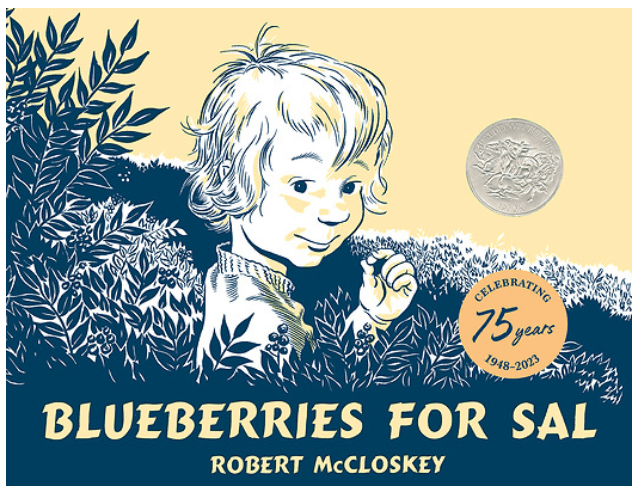
    “Who is this girl?” asks Sloane pointing to the face of a little girl drawn in blue ink against a yellow sky.
    “That’s Sal,” I reply, “she is eating blueberries.”

    Sal’s face is the Mona Lisa of picture books.
    She has been smiling sweetly at readers for over 75 years inviting them to read the beloved Blueberries for Sal.

    BOOK SUMMARY

    It’s summer in Maine, and Sal’s mother wants to can blueberries to have during the cold winter. She and Sal go out to pick blueberries on one side of Blueberry Hill.
    Mother Bear wants to Little Bear to fatten up for the cold Maine winter. So she and her cub hunt for blueberries on the other side of Blueberry Hill.
    The mothers gather blueberries.
    Little Sal and Little Bear eat the blueberries.
    Their paths cross, and soon Little Sal is following Mother Bear, while Little Bear is following Sal’s mother.

    “See? They’re all mixed up,” giggles Sloane before I can even read those exact words from the text.

    IDEAL AUDIENCE

    This is a good read aloud for children starting at age 2 through age 6. The names of the characters (“Little Sal” and “Little Bear”) are easily understood, and the illustrations are simple and realistic.
    Plus, there is the pleasure of making the sounds of berries hitting the bottom of a metal pail:

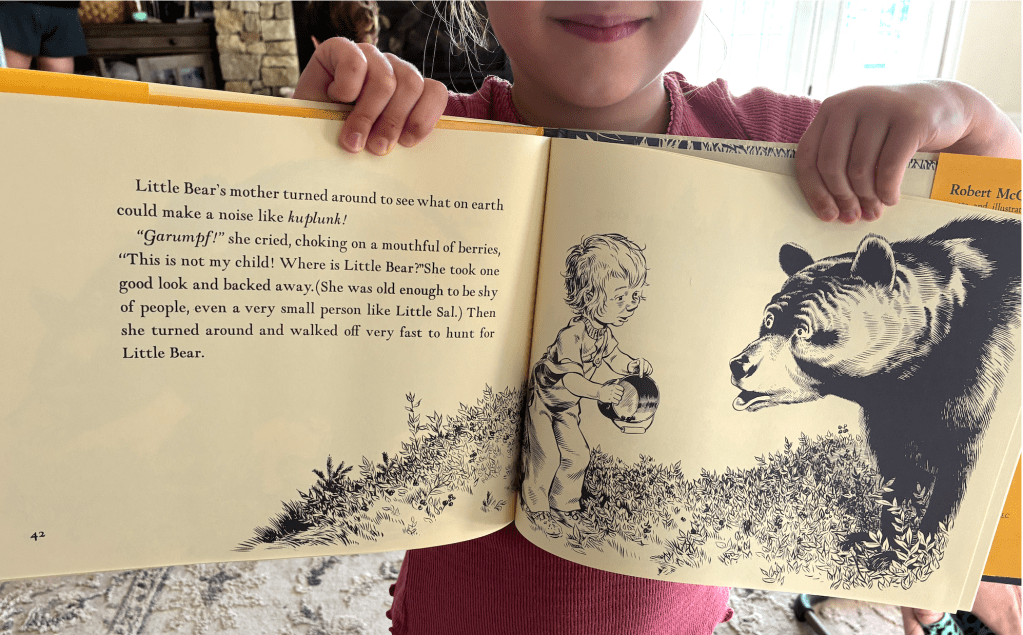
    Little Sal picked three berries and dropped them in her little tin pail. . .
    kuplink, kuplank, kuplunk!


    As for those critics who express concerns about inattentive parenting, consider this book an opportunity to explain how important it is to stay close to a parent. And Sloan particularly enjoyed the expression on Mother Bear’s face when she realizes she has lost Little Bear.

    AUTHOR/ILLUSTRATOR

    Blueberries for Sal was written and illustrated by the iconic picture book artist, Robert McCloskey  (1914-2003). Here, his illustrations are dark blue(berry) block prints with mustard yellow background and highlights. McCloskey used his daughter Sally and his wife as models. (The bears are uncredited)
    Blueberries for Sal received a Caldecott Honor for illustrations, as did his books One Morning in Maine and Journey Cake (by Ruth Sawyer). He received full Caldecott Awards for his other classic picture books Make Way for Ducklings and Time of Wonder.

    Because of his contributions to children’s books, McCloskey was declared a Living Legend by the Library of Congress in 2000.

    ADDITIONAL READ -ALOUD INFORMATION


    This story is a Maine story. As a tribute, Congresswoman Chellie Pingree of Maine recently posted on Facebook:

    “In honor of America’s 250th birthday, each Congressional Delegation was invited to place a few items in a time capsule, to be sealed inside the US Capitol until 2276.
    In the end, my team and I felt strongly about including a copy of Blueberries for Sal, Robert McCloskey’s timeless children’s book about a little girl who goes blueberry picking with her mother—only to cross paths with a bear cub and its mother.
    I can’t foresee the challenges the next 250 years, for Maine or our country. We may wander off the trail at times. But my hope is that we can always find our way back home—with a deeper appreciation for the beauty of the world, a better understanding of all who inhabit it, and, of course, buckets full of blueberries.
    Here’s hoping whoever opens it in 2276 still knows the sound: kuplink, kuplank, kuplunk. 🫐🇺🇸

  • Read Me This Book: “Strega Nona”

    “Grandma” asks Sloane, “why does this book get a medal?”

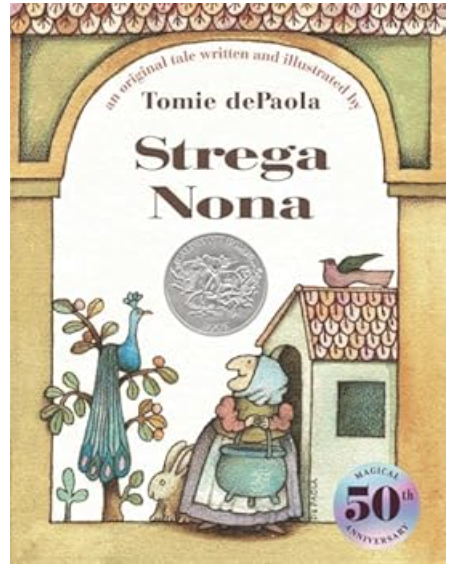
    She is pointing to the shiny medallion pasted on the cover of Tomie dePaola’s Strega Nona. This sticker reads “50th Magical Anniversary”.

    I show Sloane the other medallion that has been printed on the cover as well.

    “This other medal,” I tell her, “is because this book won for having the best pictures.”
    “Two medals?” Sloane considers, “then, this must be the best book of all!”

    She is not wrong.

    BOOK SUMMARY

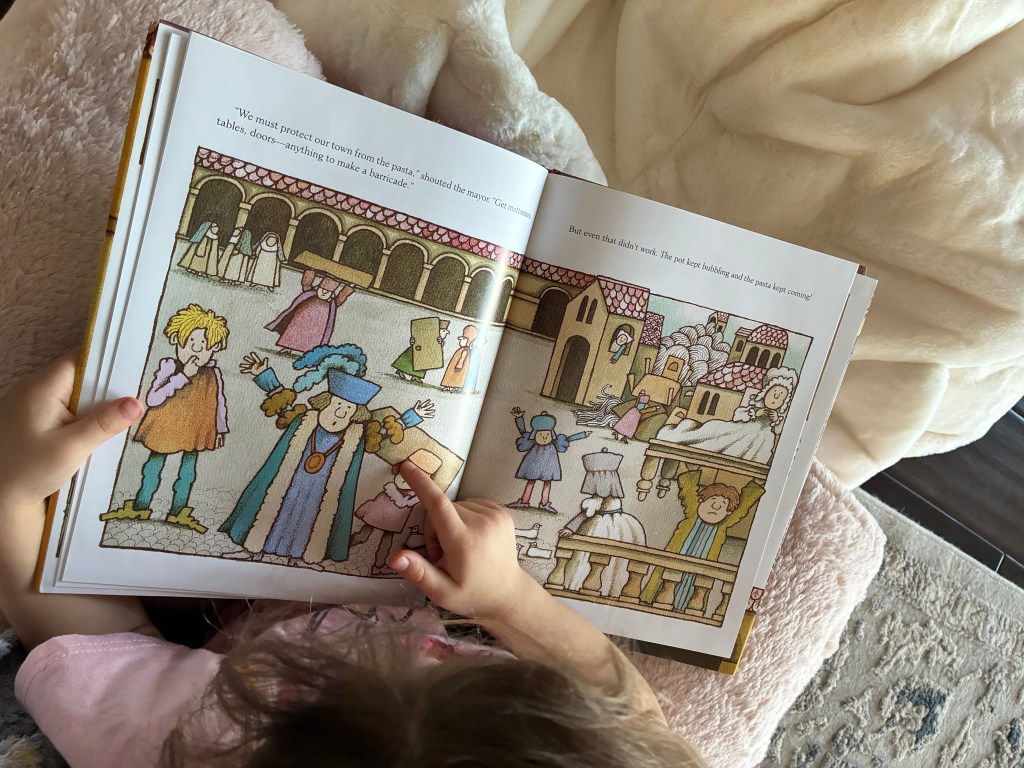
    Strega Nona is an Italian folktale about an older woman who hires an apprentice (Big Anthony) to help her with her chores with disastrous results.
    Her name, Strega Nona, literally translates to “Grandma Witch”. She takes care of a variety of problems in her village: curing headaches, removing warts, and making potions for girls who want husbands.

    “Although all the people in town talked about her in whispers, they all went to see her if they had troubles. Even the priest and the sisters of the convent went, because Strega Nona did have a magic touch.”

    She also has a magic pasta pot.

    So when Strega Nona leaves town and puts Big Anthony in charge, that magic pasta pot becomes too tempting. Big Anthony decides to show off, and before long, pasta is flowing freely in the streets.

    Strega Nona returns to stop the pasta from flooding the village with her three magic kisses.


    IDEAL AUDIENCE

    Strega Nona is suggested for children 2-5 years old, however, it is also a favorite of teachers who are teaching folktales to 2nd or 3rd grades. Students identify the problem and understand the moral of the story (“do as you are told”), although some see the punishment as rather harsh…Big Anthony must eat the pasta flood!

    The award-winning illustrations are very detailed. The 15th century clothing and village architecture are colorful and charming, not confusing. In fact, Sloane loved all the hats and veils.

    AUTHOR/ILLUSTRATOR

    Tomie dePaola is one of the best known author/illustrator of children’s books. One can easily identify his distinctive style of round-faced characters in agitated positions. He was the recipient of the Newbery Honor for 26 Fairmount Avenue  (2000), the Caldecott Honor for Strega Nona (1976), and the 2011 Children’s Literature Legacy Award for “significant and lasting contribution to children’s literature” with over 270 books to his credit. He died in 2020.

    There are about 15 books that are part of the Strega Nona series. Big Anthony gets his own book as well!


    ADDITIONAL READ -ALOUD INFORMATION

    Strega Nona may be the first “banned” book that I have read aloud to my grandchildren.  Apparently the most serious objection is the positive depiction of a witch.

    In reading the story, one gets the sense that dePaola may have anticipated such concerns and deliberately placed the village’s priest and gaggle of nuns at different points in the story.

    They are seen being directly helped by Strega Nona. They eat the pasta from the magic pasta pot, and they are (eventually) saved from the pasta flood by Strega Nona when she returns. Their role in the story suggests that Strega Nona’s kind of magic is acceptable and even beneficial.

    Such religious characters also provide authenticity, after all, what Renaissance Italian village would not have a priest and a convent full of nuns?

    As for Sloane, she thinks the book should be available to everyone. She gives it a rating of three magic kisses!

  • Read Me This Book: Jumper

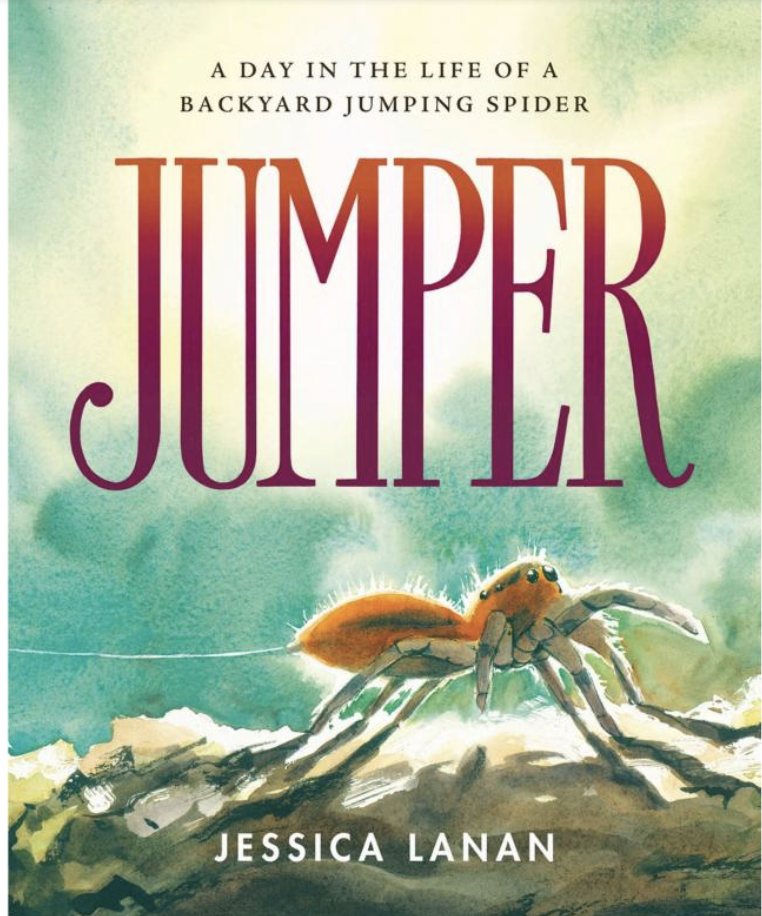
    Finding a good non-fiction picture book for young children can be a little challenging. Jumper: A Day in the Life of a Backyard Jumping Spider is a “find”, both for its excellent storyline with illustrations and for its subject matter…spiders!
    Sloane loves spiders. She loves finding their webs.
    She is the spider protector in her house.

    BOOK SUMMARY


    Jumper” is as advertised, a day in a backyard where a spider is both predator and prey. The picture book begins with a fact-filled question:

    What if you were small as a bean,
    Could walk on the walls and ceiling,
    Sense vibrations through your elbows,
    And jump five times your body length?

    For young readers who are also small, these would be amazing qualities to have!
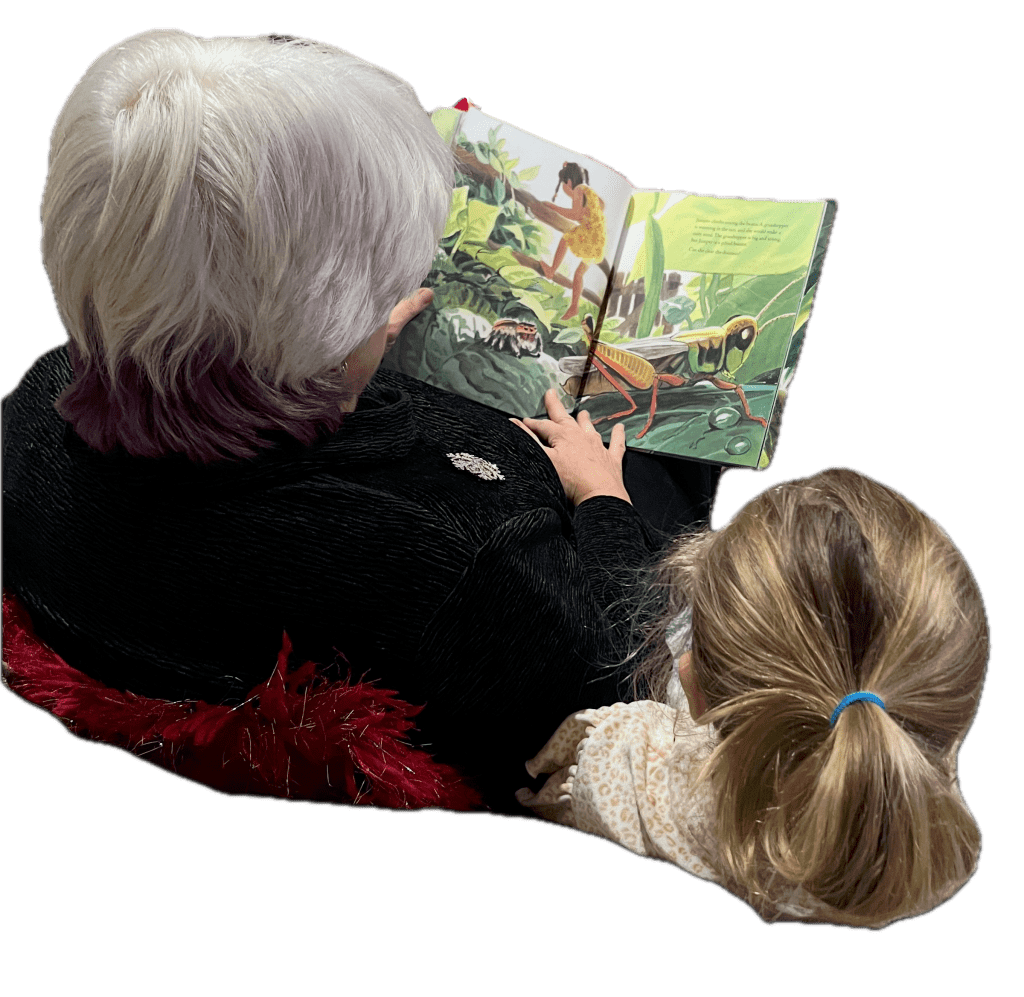
    The detailed illustrations use multiple different points-of-view. A backyard fence that a young girl can climb over is later pictured as a towering wall of wood planks for Jumper the spider.
    Despite the switch in points-of-view, Sloane is never confused. She is quick to point out how little Jumper is in relation to other insects who may appear larger.
    “That’s so big a fly Jumper caught!” she admires.
    There is also an illustrated “slo-mo” jump that also provides some perspective. A spider jump of five times its body length is compared to that of a young girl jumping a proportionate distance of five times her size.

    The factual information about jumping spiders does not get in the way of a gripping storyline. On several pages, birds circle above the yard adding a bit of dramatic tension to the story. This tiny spider must eat to survive while trying to survive not being eaten.

    While Jumper is a good read-aloud for young children, the picture book has a longer audience-appropriate life span. The supplemental information in the back of the book (“Spider Paws”, “Exceptional Vision”, “Silk tougher than Steel”, etc.) can provide details useful for science classrooms or competitive sessions of after-dinner Jeopardy!

    AUTHOR/ILLUSTRATOR

    Jessica Lanan is the award-winning author/illustrator of this book receiving the Robert F. Sibert Honor, 2024; ALA Notable Book, 2024: Cybils Award for Elementary Nonfiction, 2023; Golden Kite Honor for Picture Book Illustration, 2024, among others.
    On her website, Lahan explains how she wants to, “discover beauty and wonder in the world by creating picture books that are inspiring, accessible and memorable.” Her extensive research on jumping spiders is also evident.
    She has also written and illustrated The Fisherman and the Whale, and collaborated as an illustrator on The Lost Package by Richard Ho.

    ADDITIONAL READ -ALOUD INFORMATION


    On Lahan’s website there are additional links for downloadable materials that can be used at home or in the classroom: a coloring page, a spider’s anatomy page, and an empathy activity.

    Sloan loves nature walks, looking for animals and bugs when we are outside. Jumper has added to her background knowledge and encouraged her to look more closely at their activity.

    For me, I am thrilled that Sloane is not intimidated by spiders, indoors or outside. Since she loves Jumper, I know of another special spider, a spider named Charlotte, that I cannot wait to introduce to her!

  • Read Me This Book – “Cat”

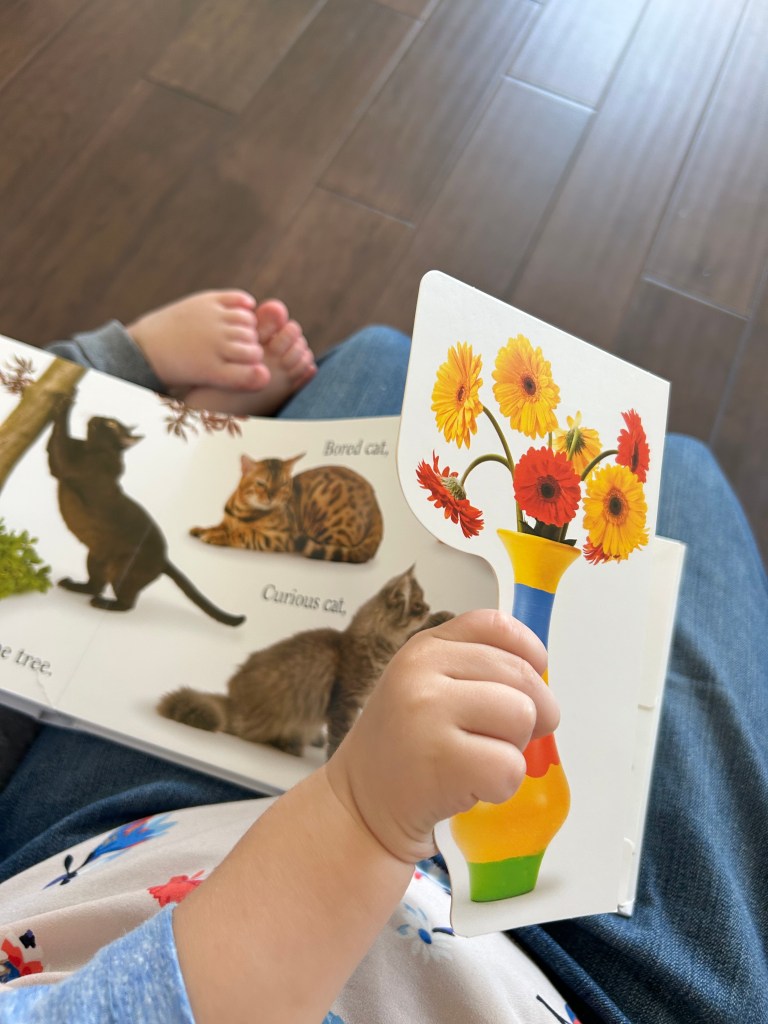
    David loves pop-up books.
    David also loves cats.
    So, it is no surprise that David loves to have me read the pop-up book Cat…repeatedly.

    Summary:
    There is no “plot” to this pop-up book.
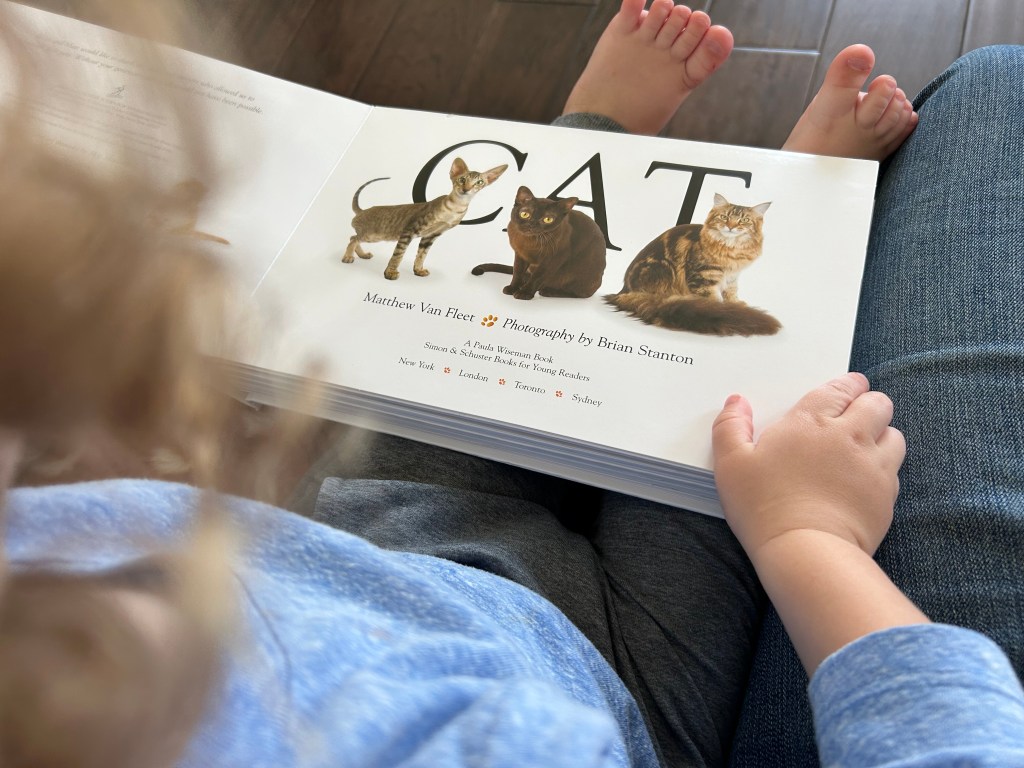
    Instead, there are photographs of over 20 breeds of cats. These personality portraits are labeled with clever names like “cool cat” or “alley cat” or “scaredy-cat”.
    Young readers (and old) can play with multiple interactive pull-tabs and flaps that have cats “dipping” their paws in fishbowls, “pushing” balls of yarn or “peeking” out of rainboots.
    The final pages feature the entire cast of cats, and one dog, with each of their names and breed.

    Audience:
    Two truths:
    1. Toddlers love pop-up books, however,
    2. Pop-up books break.
    My David is a toddler and an expert destroyer of a pop-up book.
    But Cat is a particularly well-designed pop-up book. The flaps and tabs are thick enough to survive the tugging and pulling of his toddler fingers.
    Cat lovers could be another target audience. The cat portraits are charming and often humorous. The third of American households that own a cat might enjoy the portrayal of the different breeds.

    Author/Illustrator
    Matthew Van Fleet is a creative artist with multiple pop-up books to his credit. Several of his pop-ups feature other animals: Dog, Pet, Moo.
    He is a best-selling author with over 9.6 million copies of his books sold.

    Van Fleet’s collaborator Brian Stanton is a commercial photographer with a stellar ability to capture an animal’s personality.

    Reading Opportunities:
    Question: Can a two-year-old get a joke?
    Answer: One of the interactive puns delights David.


    A vase is pictured on a flap.
    David lifts the flap.
    A mortified cat is pictured beside broken pieces of the vase.
    I read and exclaim, “Catastrophe!”
    David chortles at the cat and points to the broken vase.
    He lifts the flap again and again and giggles each time.
    Proof that the pop-up book Cat is both artfully designed and that, yes, toddlers get the joke.

  • Read Me This One- “We’re Going on a Bear Hunt”

    This past fall (2025), National Public Radio celebrated the 35th Anniversary of Michael Rosen and Helen Oxenbury’s picture book “We’re Going on a Bear Hunt”. My own 35 year old copy is well-worn, so I bought one of the anniversary copies to read to Sloane and David.

    The picture book was very well-received!

    SUMMARY:
    The story of We’re Going on a Bear Hunt is based on a camp song, a call and response musical dialogue between the reader and a chorus.
    The leader sings each line (the call) which is then repeated by the chorus (the response) in a chant:

    LEADER: We’re going on a bear hunt!
    CHORUS: We’re going on a bear hunt!
    LEADER: We’re gonna catch a big one!
    CHORUS: We’re gonna catch a big one!
    TOGETHER: What a beautiful day!
    We’re not scared…
    .

    Now, in addition to the song, there are hand motions:

    LEADER: Oh no!
    Grass! Tall, wavy grass! (wave hands)
    TOGETHER: Can’t go over it!
    Can’t go under it!
    Gotta go through it!
    Swishy swashy, swishy swashy, swishy swashy, swishy swashy

    (hand motions separate imaginary high grass)

    The bear hunt goes through the mud (squishy-squish), a river (splish-splash), and a forest (stumble-trip) until the participants enter a deep-dark cave with (you guessed it!) A BEAR!

    AUDIENCE:
    Children ages two (2) years and older LOVE participating in reading a book and singing verses that include hand gestures. Older children, and most adults, may already be familiar with this bear hunt song.

    AUTHOR/ILLUSTRATOR:
    Michael Rosen (79) and Helen Oxenbury (89) are neighbors and during the NPR interview, they discussed how they combined their different ideas in creating the original picture book. Rosen had thought the story should be “a bit like Carnival” whereas the soft-spoken Oxenbury saw the story as a family adventure of older and younger siblings.

    Their collaboration 35 years ago reflects Oxenbury’s watercolor artistry across different landscapes because, as she noted, “it’s a very English way of painting.”

    Rosen and Oxenbury released their latest collaboration “Oh Dear, Look What I Got”-a storytime comedy of misunderstandings- in September 2025. This picture book has also received high praise, “from a team whose talents haven’t aged a day.” (Kirkus Reviews)

    OTHER:
    Sloane was an enthusiastic participant in the bear hunt from the start. She quickly understood how to respond and when to use hand motions. But she also was very solemn in her advice after reading, “Grandma, we should not try to wake up a real bear, OK?”

  • Read Me This One-“Wolf in the Snow”

    Winter is here, and Sloane is looking forward to snow.
    She has also developed a serious interest in wolves (or “wolfs” as she calls them).
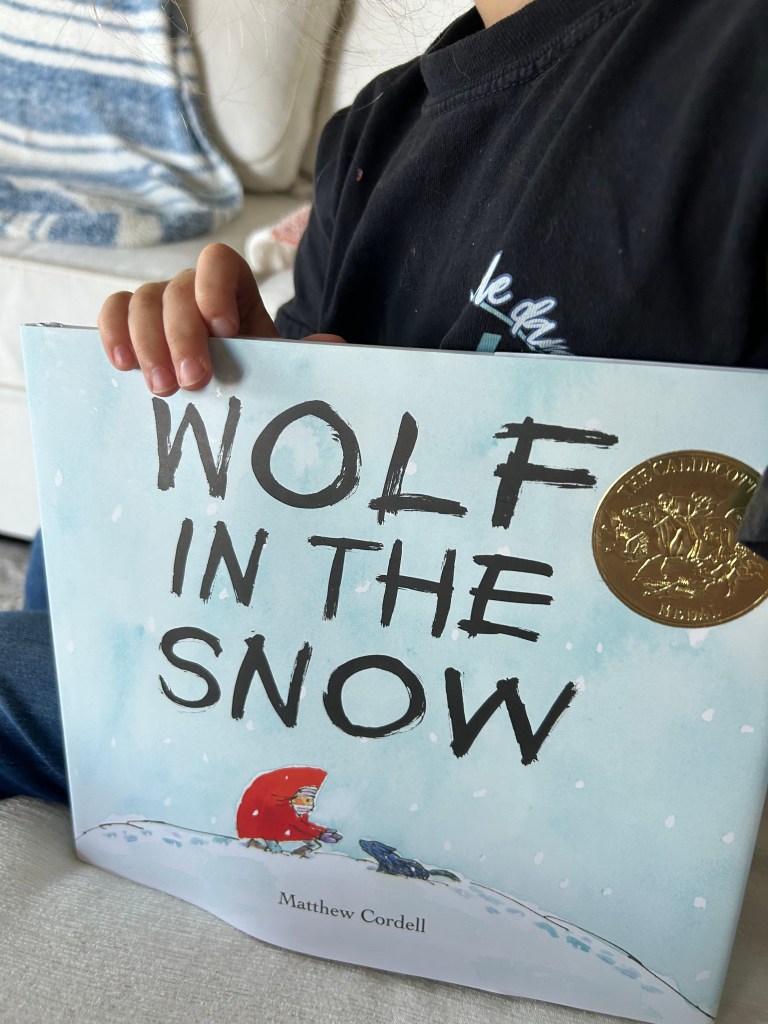
    So, what better way to capture both of her interests than in a picture book titled Wolf in the Snow ?

    SUMMARY
    Wolf in the Snow recounts the adventure of a young girl who encounters a lost wolf pup during a swirling snowstorm.
    The young girl comes upon the wolf pup on her way home from school. The drifting snow makes travel difficult, but the young girl carries the wolf pup even as the snow accumulates. The young girl is determined but the growing mounds of snow make travel difficult. Travel is also difficult for the wolfpack that is hunting for their lost pup. Eventually, the wolfpack and the young girl come face to face…and the tension is real!
    Of course, the story brings to mind the fairy tales like Little Red Riding Hood (EX: the girl wears a red coat, the girl is on her way to a house).
    The ending, however, is not Grimm Brothers gruesome, but wholly satisfying to wolf lovers of all ages.

    AUDIENCE:
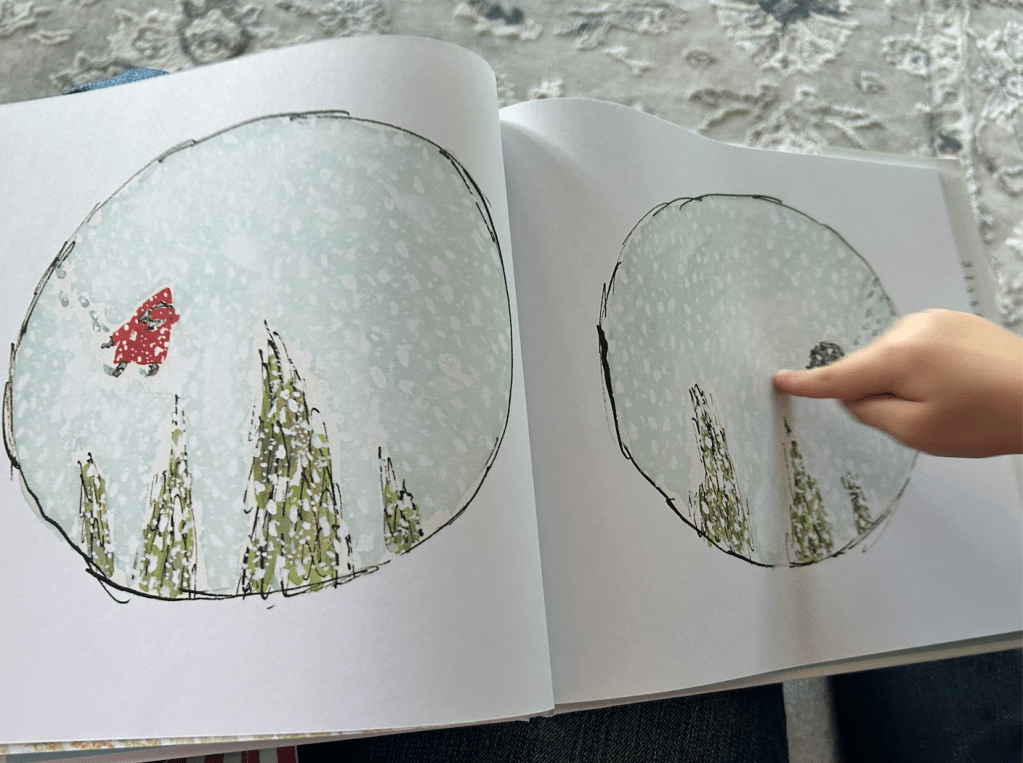
    Wolf in the Snow is an almost totally wordless picture book, ideal for readers of all ages (2 years and up). As the text is in the pictures, there are multiple ways readers may choose to “tell” this story.
    There are children who will want to linger over the details embedded on each page. And for toddlers who may have a short attention span, this book can be a fast read.
    Note: There is no dialogue, but be prepared to give a few “howls” or “barks”.

    AUTHOR/ILLUSTRATOR:
    Wolf in the Snow was released in 2017 by author/illustrator Matthew Cordell. The book was favorably received by critics and was awarded the 2017 Boston Globe-Horn Book honor award and the 2018 Caldecott Medal for illustrations.

    All of the pages have illustrations that feature the falling snow. The lightly falling flakes at the beginning soon give way to swirling whiteout conditions.
    This is very dramatic snow!

    Cordell has written and illustrated other picture books, including Trouble Gum, King Alice, Another Brother, and Hello! Hello!

    READING OPPORTUNITIES:
    A word of caution when choosing a wordless picture book for a three-year old. There will be MANY questions. most beginning with “WHY?” For example:

    • “Why does the girl go to school in the woods?”
    • “Why is she walking by herself?”
    • “Why is the wolf cub alone?”
    • “Why is she tired?”
    • “Why does the wolf pack howl?”

    All good questions.
    Wolf in the Snow answers “why” and more.

  • Read Me This Book: Pinkalicious

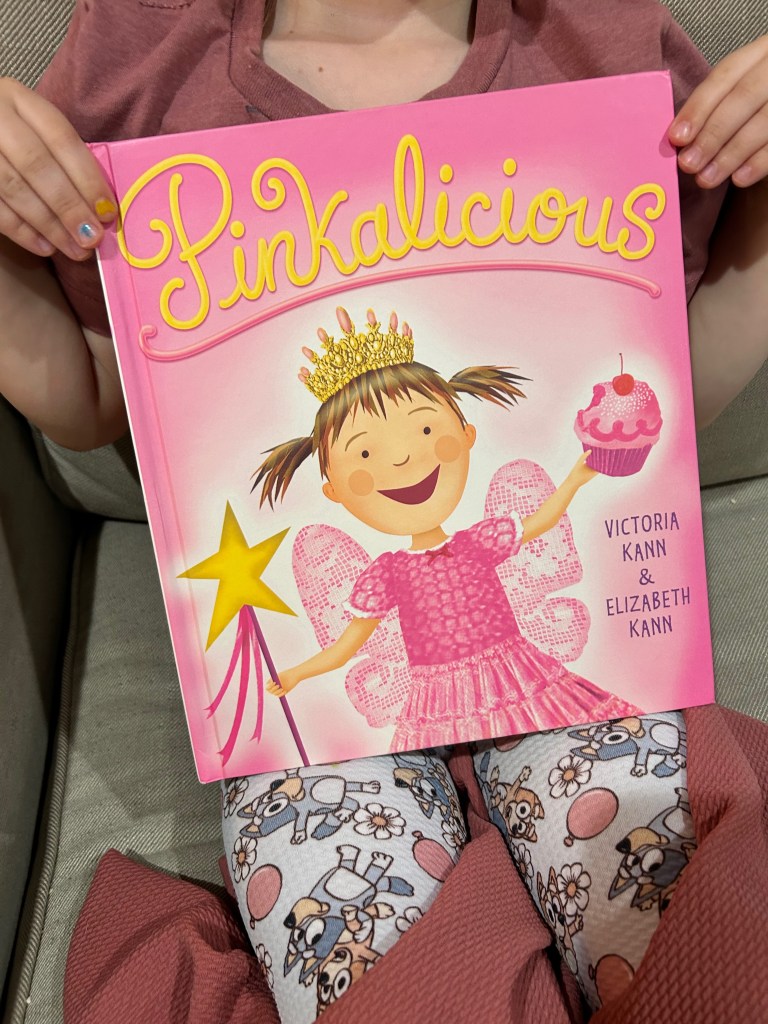
    “I want pink…pink…Pinkalicious!” exclaims Sloane.
    This picture book is a frequent choice for her.
    I can also appreciate this genius idea of selling the color pink to little girls.

    SUMMARY:

    In the beginning, Pinkalicious (and yes, that is her name) makes delicious pink cupcakes with her mother. But, she eats so many of these mouthwatering pinky sweets that eventually her parents say “NO MORE”!

    However, her enthusiasm for pink cupcakes does not stop. Soon her skin turns pink, a medical condition known as “pinkititus ” according to her doctor:

    “The next morning when I woke up, I was pink!
    My face was pink, my hands were pink and my belly was pink!”

    So her doctor prescribes a remedy of green foods.
    Even then, Pinkalicious will not be stopped from dining on pink cupcakes until she wakes up and discovers that eating all that pink has left her RED!

    The cure for such disobedience?
    Pinkalicious must feed on “icky green relish,” artichokes, brussel sprouts, spinach or any other green vegetable in order to return to her pre-pink state.

    AUDIENCE:

    The book is recommended for readers 4 to 8 years, but pink-loving toddlers will enjoy many of details in the illustrations. For example, Pinkalicious’ princess/ fairy ensemble, a pink chiffon dress accessorized with wand and tiara, is a fashion statement admired -and sometimes duplicated- by Sloane.

    AUTHOR/ILLUSTRATOR:

    Pinkalicious was co-written by sisters Victoria and Elizabeth Kann with Victoria doing the illustrations. Apparently the plot of the book began as an April Fool’s joke when Victoria sent the story to friends and family explaining that her daughter turned pink after eating too many pink cupcakes. 

    The book was first published in 2006, and was followed by Purplicious (2007), Goldilicious (2009) and Silverlicious (2011).
    Victoria has continued writing and illustrating with 64 books in the Pinkalicious series.

    READING OPPORTUNITIES:

    Pinkalicious is an entry level start to young reader picture book schadenfreude, better known as the state of taking joy in the misfortune of others.

    As evidence, Sloane stares intently at the illustration of Pinkalicious stamping her feet.
    “She’s being bad!” she will tell me happily.

    Sloane understands that if you disobey your parents, then bad things will happen. She clearly enjoys the misfortunes of Pinkalicious and is delighted to explain to me, “See? She got red.”
    Then, she will laugh.

    Oddly enough, Pinkalicious has been banned in schools in at least one state when parents raised concerns about the main character eating too many sweets.

    I am confident that Sloane could happily explain the book to those parents.

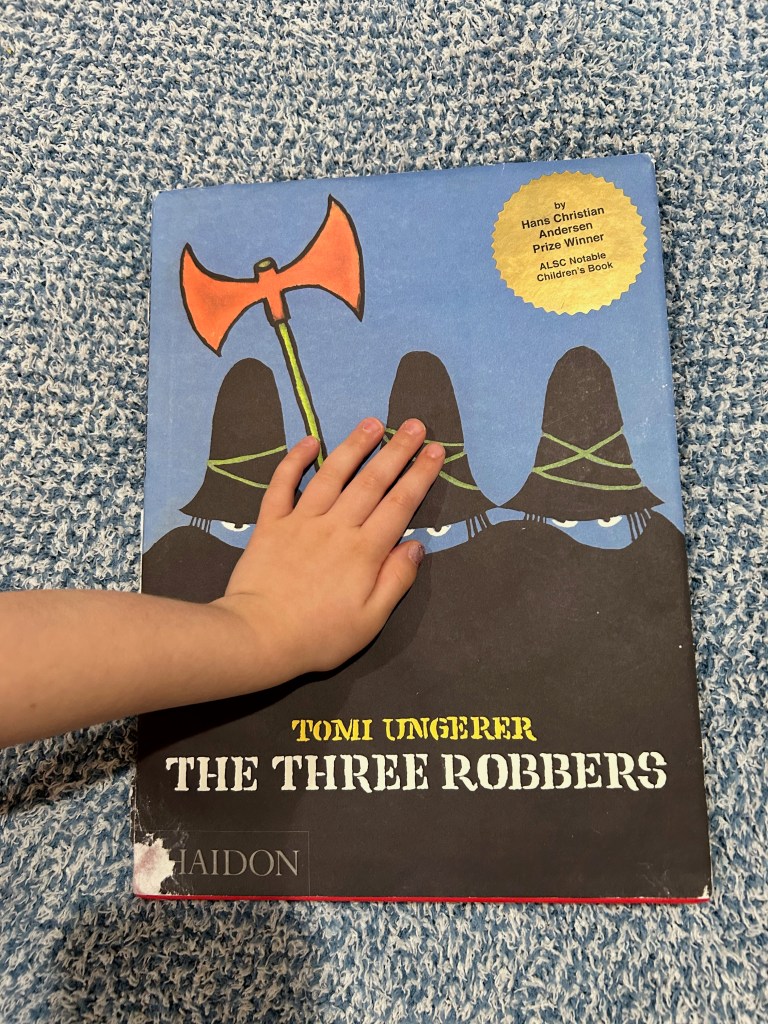
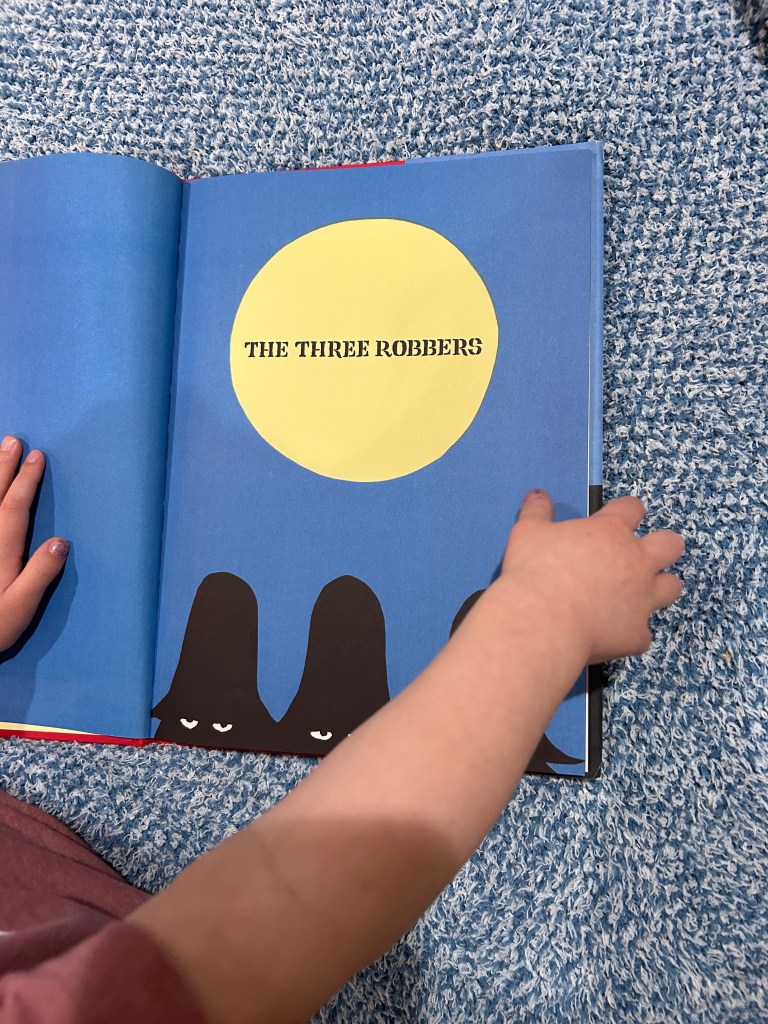
  • Read Me This Book: The Three Robbers

    I admit that Sloane did not pick The Three Robbers as a bedtime story.
    I did.
    But the cover art with three villainous characters and one huge red axe caught her attention, and she agreed.

    Now, this picture book is included in our rotation of bedtime reads.

    SUMMARY
    The Three Robbers is a simple folk tale and begins as most folk tales do:

    “Once upon a time, there were three fierce robbers.”

    These fierce robbers terrorize travelers using three very dangerous -but attractively illustrated – weapons:

    • Pepperblower: “To stop carriages, the robbers blew pepper into the horses’ eyes.”
    • Huge Red Axe: “With the axe, they smashed the carriage wheels.”
    • Blunderbuss: “And with the blunderbuss, they threatened the passengers and plundered them.”

    The robbers carry their stolen goods to a cave high in the mountains. One night they stopped a carriage, and take the only thing of value, a little girl name Tiffany.
    When Tiffany sees all the treasure piled into the cave, she asks the robbers what they intend to do with their trunks of gold?
    A change of heart ensues, and the three robbers decide to use their ill-gotten gains to help lost or abandoned children.

    AUDIENCE:
    Words such as “threatened”, “plundered”, “loot”, “abandoned”, and “blunderbuss” are not the usual vocabulary a reader expects in a picture book for children. But, the vivid illustrations in primary colors (dark blues, bright reds, and creamy yellows) will capture the attention of even the most distracted toddler.

    Moreover, these illustrations help to define the words.
    Faceless, the robbers’ eyes peer out from under their enormous black caps. (“threatened”). The passengers are seen being robbed (“plundered”), a small child is left alone on a doorstep (“abandoned”), and that “huge red axe” is huge and red…and menacing!

    That said audiences from ages 3 to adult will enjoy this picture book, although many recommendations place the text in ages 8-14.

    AUTHOR/ILLUSTRATOR:
    The French author/illustrator Jean-Thomas Ungerer published The Three Robbers in 1961. (Tomi) Ungerer grew up in the Nazi occupied region of Alsace, France. That experience may account for the sometimes dark turns one might read in his books or see in his illustrations.

    As a young man, Ungerer was influenced by illustrations in The New Yorker magazine. From 1951-1974, he wrote and illustrated over 30 children’s books (including the notable Moon Man and the art for the first editions of Flat Stanley) before switching to writing satire and more adult themed literature. (including the 1964 film poster design for Dr. Strangelove) .

    He was awarded the Commander of the Legion d’Honneur (2018), and the
    Hans Christian Andersen Award for Illustration (1998).

    Ungerer passed away in 2019. His website: https://www.tomiungerer.com/books

    READING OPPORTUNITIES:

    The Three Robbers was a favorite bedtime read of Sloane’s father. He would echo back the words to me as we read…”blunderbuss”…”axe”…”plunder”.
    He was not interested in Tiffany.
    He liked the robbers.

    The book has little text in its 40 pages. I found a used copy several summers ago, and I put it aside so that we would always have a copy. I did not want this title to disappear into obscurity.

    I need not have worried. This past June 2025, The NYTimes Book Review published The Lemony Snicket Anti-Summer Summer Reading List for children. There was The Three Robbers, #3 on the recommendation list for children 8-14.

    In his review, Snicket poses the question, “What child ever forgets their first encounter with the word ‘blunderbuss’?”

    Really, what child would?