Sloane hands me the book Snow.
“Read me this one, Grandma,” she says.
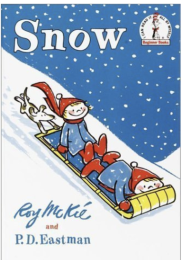
I instantly recognize the cover.
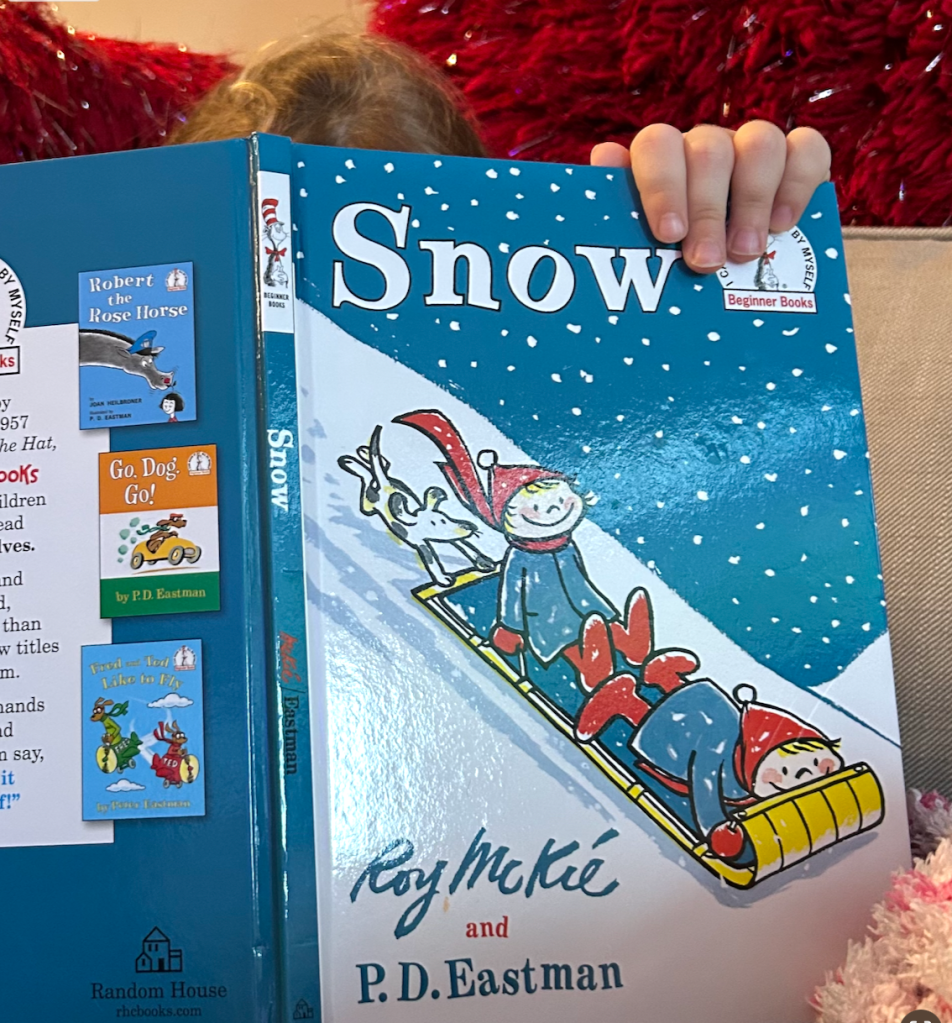
Two children are in a toboggan racing down a hill. Their very wide faces have very wide smiles. A dog hangs off the back, front paws clutching the sled, back legs up off the ground.
Snowflakes are everywhere.
Speed. Joy.
It’s a very active illustration.
“Snow!” I exclaim to Sloane. “I know this book. It’s about all the things you can do in the snow.”
Summary:
The plot is simple. Two children go out and play in freshly falling snow. They catch snowflakes on their tongues. They sled. They watch sleigh rides. They make a large snowman.
The rhymes are simple and repeatable.
“What is snow?
We do not know.
But snow is fun
To dig and throw.”
There are several verses in this book that echo the verses in other children’s books (such as the questions posed in Green Eggs and Ham):
“Do you like snow?
Do you like it?
Yes or no?”
“Oh yes, oh yes!
I do like snow!”
and
“Do you like it in your face?”
“Yes, I like it any place.”
By the book’s conclusion, the children save what is left of a melting snowman in their refrigerator for another day.
Audience:
Snow is a wonderful picture book as a pre-school read, but it was originally designed as an early reader book for the Beginner Book Series. This series was founded by Phyllis Cerf and Ted Geisel in 1957 starting with the publication of The Cat in the Hat.
All Beginner Books were developed using the vocabulary from a list of 379 words considered basic for young readers.
That makes Snow an “I can read it” opportunity for students through grade 3.
Author/Illustrator:
I was in kindergarten when “Snow” was released, October 12, 1962. It was the 27th book released as part of the Beginner Books Series.
The author P.D. Eastman also wrote and illustrated a number of other classics including other favorites Go, Dog. Go! and Are You My Mother?
On Snow, however, Roy McKie was the illustrator. McKie was also noted for his collaborations with Theodore Geisel (Dr. Seuss). In Snow, Mckie’s illustrations are cartoon-like with primary colors-bright reds, yellows and blues.
Reading Opportunities:
The book is ideal for any season, but reading this book in the winter whenever or wherever snow is available seems particularly appropriate. Children will enjoy the illustrations even without the text.
“So, do you like snow?” I asked Sloane after we finish.
She pauses, tracing the toboggan with her finger.
“Snow the book…or the snow outside?” I continue.
It’s a silly question.
“Both,” she says.
 ReadMeThisBook
Leave a comment