Tag: book-reviews

  • Read Me This Book: “Strega Nona”

    “Grandma” asks Sloane, “why does this book get a medal?”

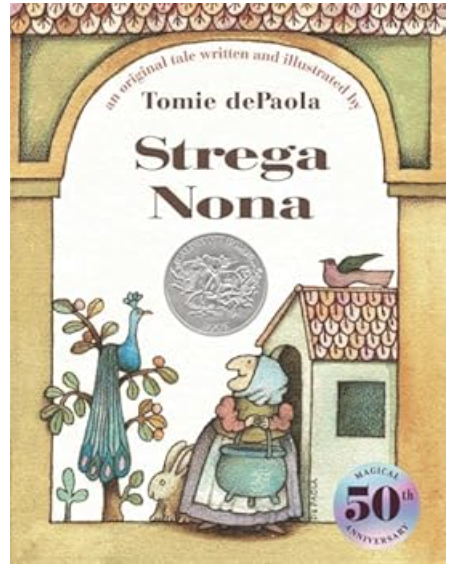
    She is pointing to the shiny medallion pasted on the cover of Tomie dePaola’s Strega Nona. This sticker reads “50th Magical Anniversary”.

    I show Sloane the other medallion that has been printed on the cover as well.

    “This other medal,” I tell her, “is because this book won for having the best pictures.”
    “Two medals?” Sloane considers, “then, this must be the best book of all!”

    She is not wrong.

    Plot Summary

    Strega Nona is an Italian folktale about an older woman who hires an apprentice (Big Anthony) to help her with her chores with disastrous results.
    Her name, Strega Nona, literally translates to “Grandma Witch”. She takes care of a variety of problems in her village: curing headaches, removing warts, and making potions for girls who want husbands.

    “Although all the people in town talked about her in whispers, they all went to see her if they had troubles. Even the priest and the sisters of the convent went, because Strega Nona did have a magic touch.”

    She also has a magic pasta pot.

    So when Strega Nona leaves town and puts Big Anthony in charge, that magic pasta pot becomes too tempting. Big Anthony decides to show off, and before long, pasta is flowing freely in the streets.

    Strega Nona returns to stop the pasta from flooding the village with her three magic kisses.

    Audience:

    Strega Nona is suggested for children 2-5 years old, however, it is also a favorite of teachers who are teaching folktales to 2nd or 3rd grades. Students identify the problem and understand the moral of the story (“do as you are told”), although some see the punishment as rather harsh…Big Anthony must eat the pasta flood!

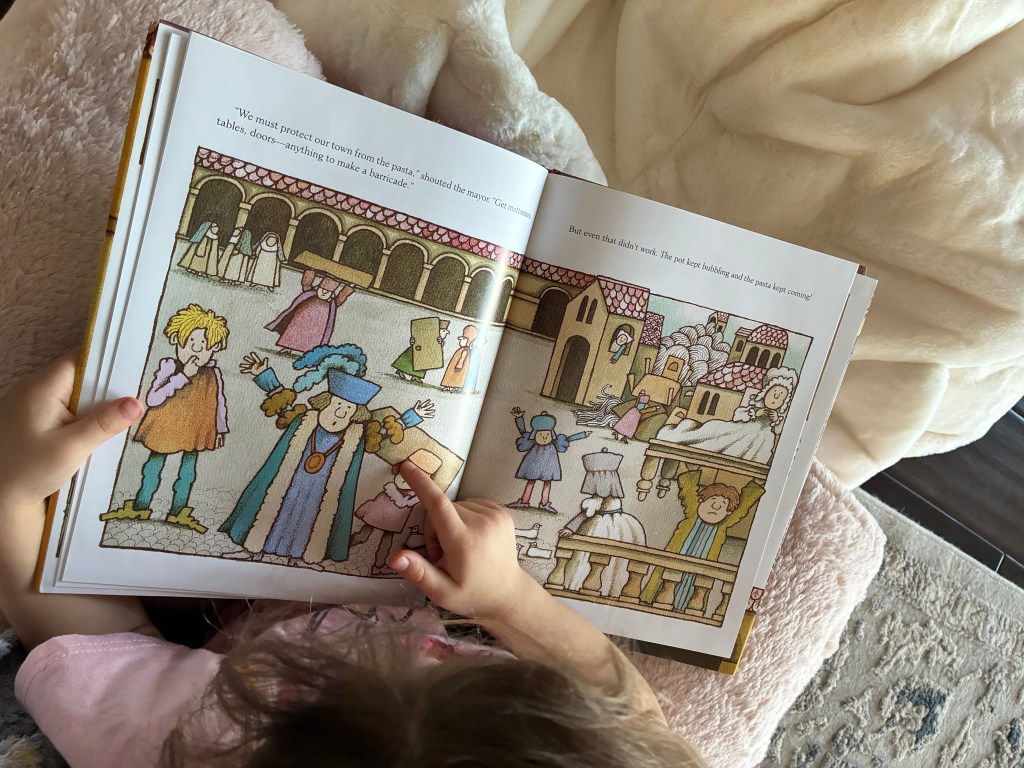
    The award-winning illustrations are very detailed. The 15th century clothing and village architecture are colorful and charming, not confusing. In fact, Sloane loved all the hats and veils.

    Author Illustrator

    Tomie dePaola is one of the best known author/illustrator of children’s books. One can easily identify his distinctive style of round-faced characters in agitated positions. He was the recipient of the Newbery Honor for 26 Fairmount Avenue  (2000), the Caldecott Honor for Strega Nona (1976), and the 2011 Children’s Literature Legacy Award for “significant and lasting contribution to children’s literature” with over 270 books to his credit. He died in 2020.

    There are about 15 books that are part of the Strega Nona series. Big Anthony gets his own book as well!

    Additional information:

    Strega Nona may be the first “banned” book that I have read aloud to my grandchildren.  Apparently the most serious objection is the positive depiction of a witch.

    In reading the story, one gets the sense that dePaola may have anticipated such concerns and deliberately placed the village’s priest and gaggle of nuns at different points in the story.

    They are seen being directly helped by Strega Nona. They eat the pasta from the magic pasta pot, and they are (eventually) saved from the pasta flood by Strega Nona when she returns. Their role in the story suggests that Strega Nona’s kind of magic is acceptable and even beneficial.

    Such religious characters also provide authenticity, after all, what Renaissance Italian village would not have a priest and a convent full of nuns?

    As for Sloane, she thinks the book should be available to everyone. She gives it a rating of three magic kisses!

  • Read Me This Book: The Three Robbers

    I admit that Sloane did not pick The Three Robbers as a bedtime story.
    I did.
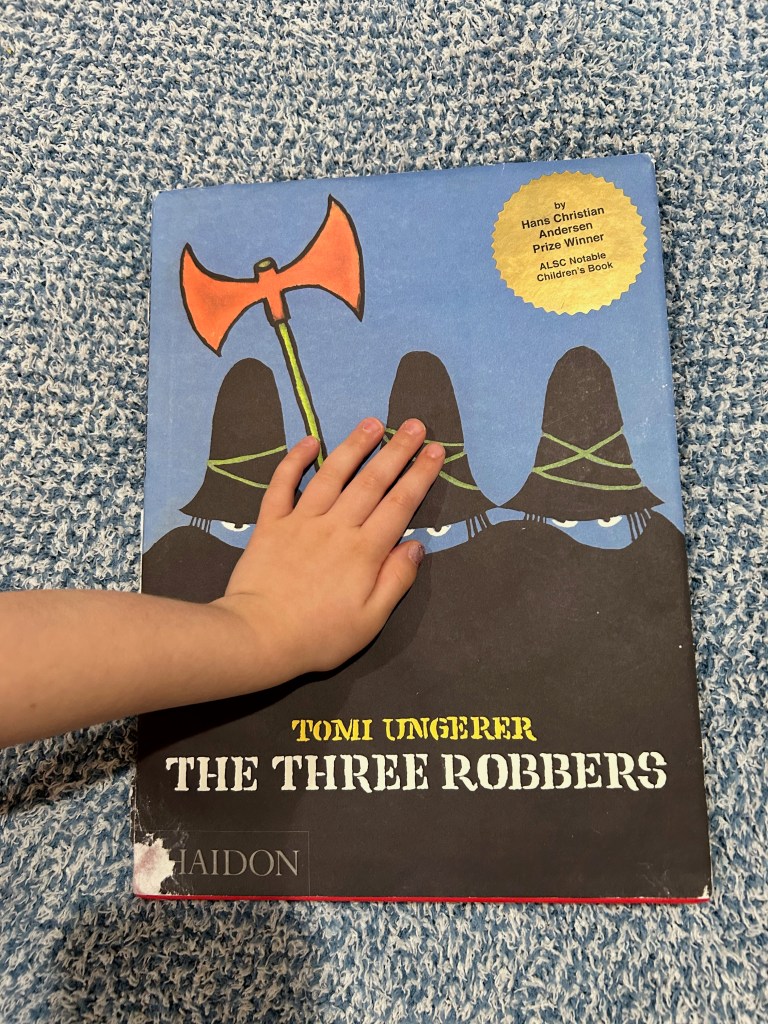
    But the cover art with three villainous characters and one huge red axe caught her attention, and she agreed.

    Now, this picture book is included in our rotation of bedtime reads.

    SUMMARY
    The Three Robbers is a simple folk tale and begins as most folk tales do:

    “Once upon a time, there were three fierce robbers.”

    These fierce robbers terrorize travelers using three very dangerous -but attractively illustrated – weapons:

    • Pepperblower: “To stop carriages, the robbers blew pepper into the horses’ eyes.”
    • Huge Red Axe: “With the axe, they smashed the carriage wheels.”
    • Blunderbuss: “And with the blunderbuss, they threatened the passengers and plundered them.”

    The robbers carry their stolen goods to a cave high in the mountains. One night they stopped a carriage, and take the only thing of value, a little girl name Tiffany.
    When Tiffany sees all the treasure piled into the cave, she asks the robbers what they intend to do with their trunks of gold?
    A change of heart ensues, and the three robbers decide to use their ill-gotten gains to help lost or abandoned children.

    AUDIENCE:
    Words such as “threatened”, “plundered”, “loot”, “abandoned”, and “blunderbuss” are not the usual vocabulary a reader expects in a picture book for children. But, the vivid illustrations in primary colors (dark blues, bright reds, and creamy yellows) will capture the attention of even the most distracted toddler.

    Moreover, these illustrations help to define the words.
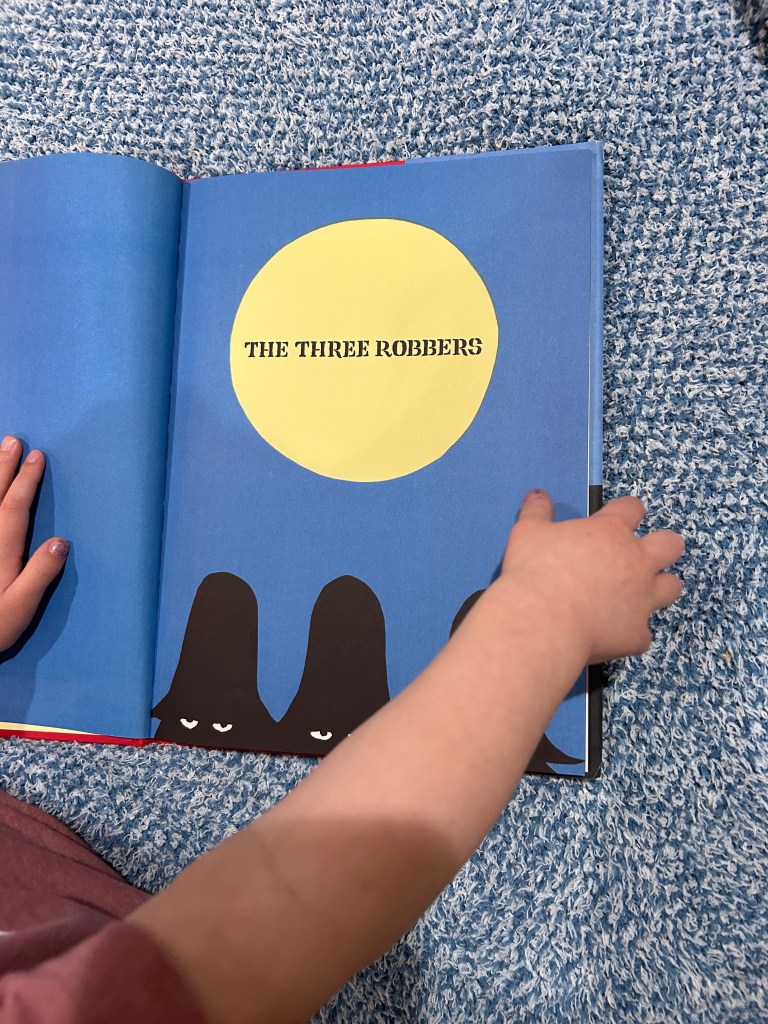
    Faceless, the robbers’ eyes peer out from under their enormous black caps. (“threatened”). The passengers are seen being robbed (“plundered”), a small child is left alone on a doorstep (“abandoned”), and that “huge red axe” is huge and red…and menacing!

    That said audiences from ages 3 to adult will enjoy this picture book, although many recommendations place the text in ages 8-14.

    AUTHOR/ILLUSTRATOR:
    The French author/illustrator Jean-Thomas Ungerer published The Three Robbers in 1961. (Tomi) Ungerer grew up in the Nazi occupied region of Alsace, France. That experience may account for the sometimes dark turns one might read in his books or see in his illustrations.

    As a young man, Ungerer was influenced by illustrations in The New Yorker magazine. From 1951-1974, he wrote and illustrated over 30 children’s books (including the notable Moon Man and the art for the first editions of Flat Stanley) before switching to writing satire and more adult themed literature. (including the 1964 film poster design for Dr. Strangelove) .

    He was awarded the Commander of the Legion d’Honneur (2018), and the
    Hans Christian Andersen Award for Illustration (1998).

    Ungerer passed away in 2019. His website: https://www.tomiungerer.com/books

    READING OPPORTUNITIES:

    The Three Robbers was a favorite bedtime read of Sloane’s father. He would echo back the words to me as we read…”blunderbuss”…”axe”…”plunder”.
    He was not interested in Tiffany.
    He liked the robbers.

    The book has little text in its 40 pages. I found a used copy several summers ago, and I put it aside so that we would always have a copy. I did not want this title to disappear into obscurity.

    I need not have worried. This past June 2025, The NYTimes Book Review published The Lemony Snicket Anti-Summer Summer Reading List for children. There was The Three Robbers, #3 on the recommendation list for children 8-14.

    In his review, Snicket poses the question, “What child ever forgets their first encounter with the word ‘blunderbuss’?”

    Really, what child would?