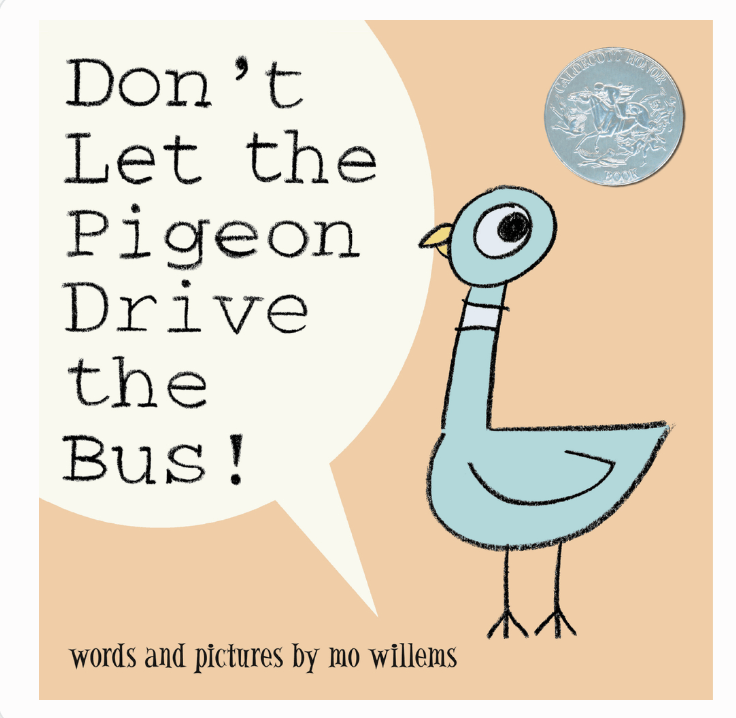
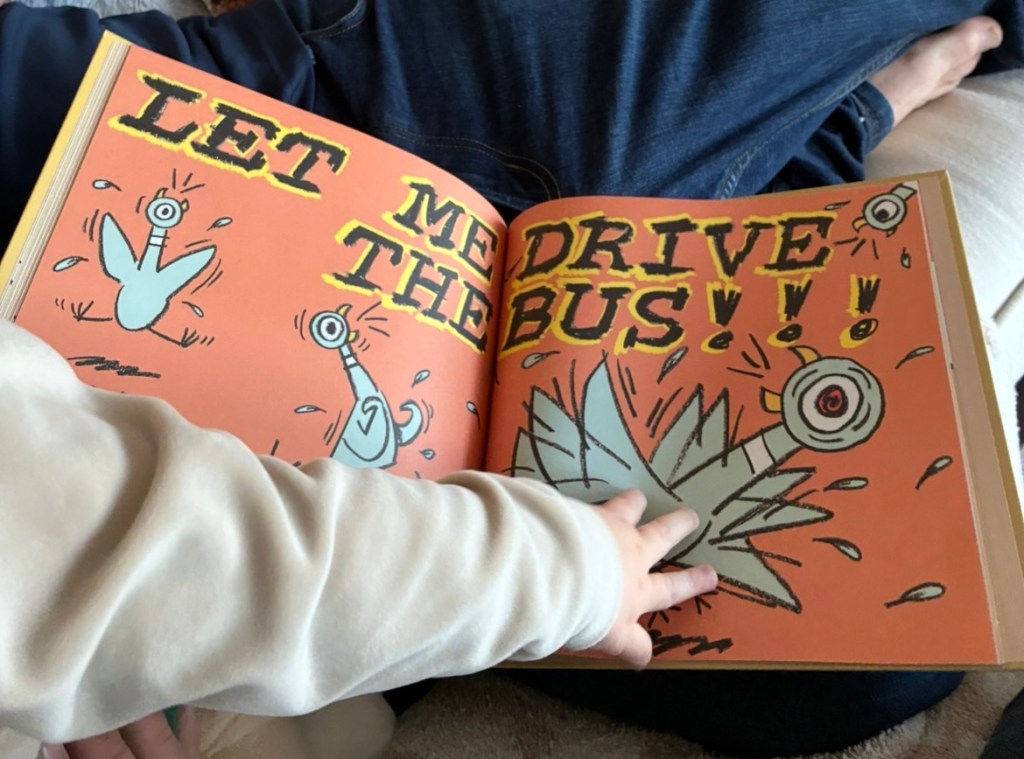
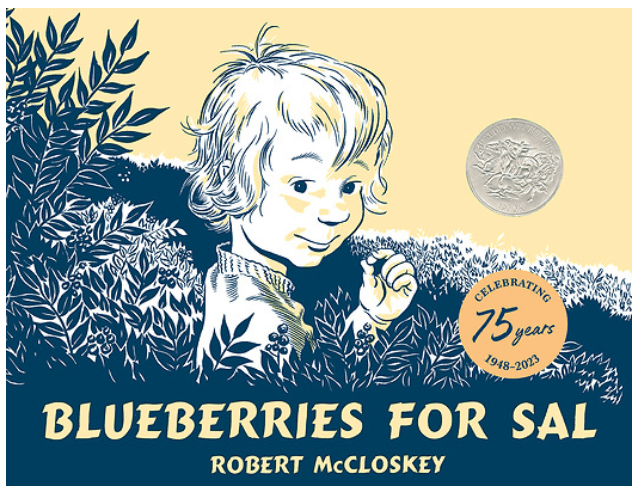
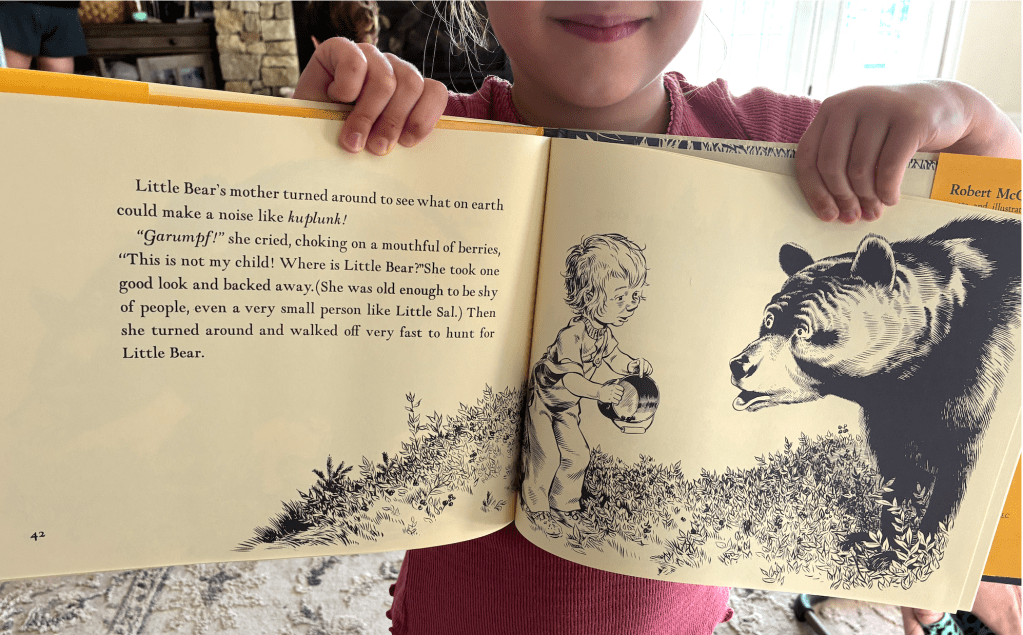
Tag: Caldecott Medal Winner

  • Read Me This Book: “Strega Nona”

    “Grandma” asks Sloane, “why does this book get a medal?”

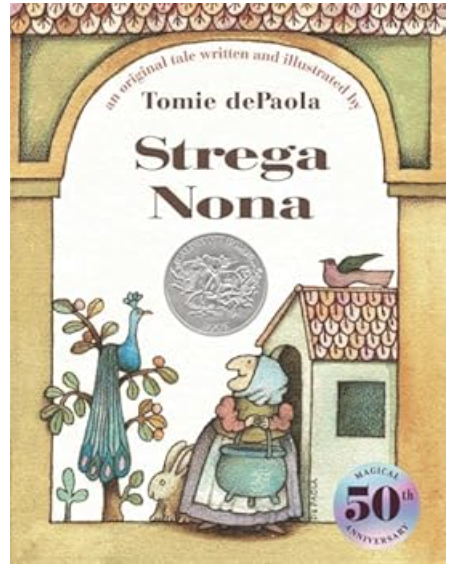
    She is pointing to the shiny medallion pasted on the cover of Tomie dePaola’s Strega Nona. This sticker reads “50th Magical Anniversary”.

    I show Sloane the other medallion that has been printed on the cover as well.

    “This other medal,” I tell her, “is because this book won for having the best pictures.”
    “Two medals?” Sloane considers, “then, this must be the best book of all!”

    She is not wrong.

    Plot Summary

    Strega Nona is an Italian folktale about an older woman who hires an apprentice (Big Anthony) to help her with her chores with disastrous results.
    Her name, Strega Nona, literally translates to “Grandma Witch”. She takes care of a variety of problems in her village: curing headaches, removing warts, and making potions for girls who want husbands.

    “Although all the people in town talked about her in whispers, they all went to see her if they had troubles. Even the priest and the sisters of the convent went, because Strega Nona did have a magic touch.”

    She also has a magic pasta pot.

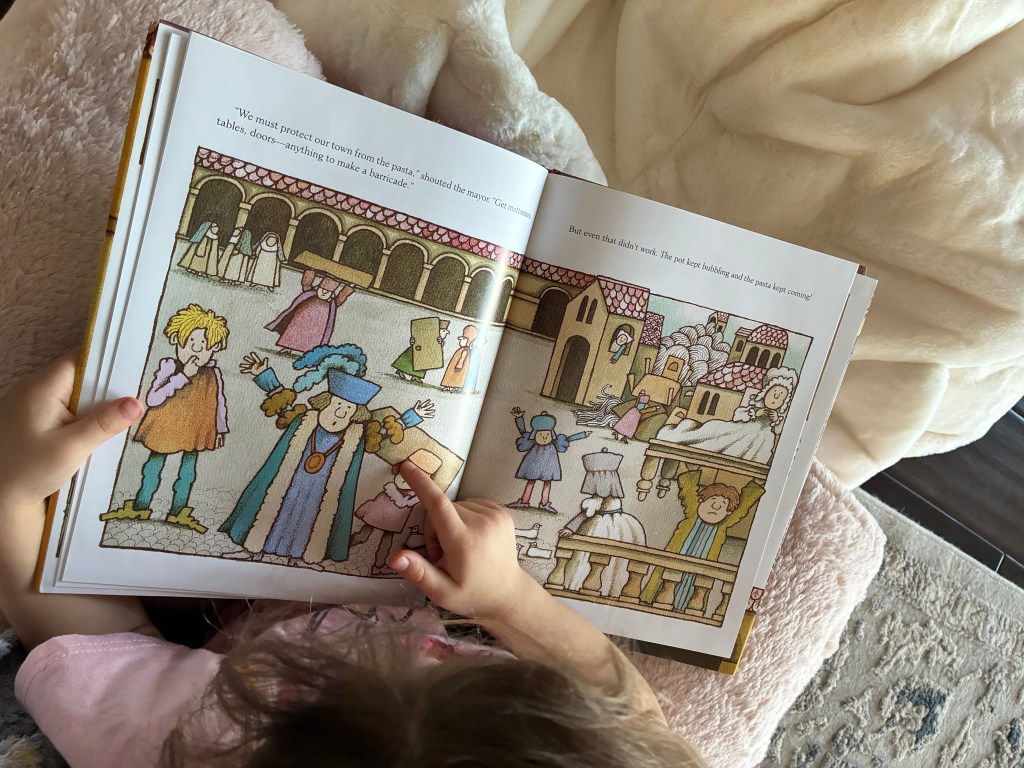
    So when Strega Nona leaves town and puts Big Anthony in charge, that magic pasta pot becomes too tempting. Big Anthony decides to show off, and before long, pasta is flowing freely in the streets.

    Strega Nona returns to stop the pasta from flooding the village with her three magic kisses.

    Audience:

    Strega Nona is suggested for children 2-5 years old, however, it is also a favorite of teachers who are teaching folktales to 2nd or 3rd grades. Students identify the problem and understand the moral of the story (“do as you are told”), although some see the punishment as rather harsh…Big Anthony must eat the pasta flood!

    The award-winning illustrations are very detailed. The 15th century clothing and village architecture are colorful and charming, not confusing. In fact, Sloane loved all the hats and veils.

    Author Illustrator

    Tomie dePaola is one of the best known author/illustrator of children’s books. One can easily identify his distinctive style of round-faced characters in agitated positions. He was the recipient of the Newbery Honor for 26 Fairmount Avenue  (2000), the Caldecott Honor for Strega Nona (1976), and the 2011 Children’s Literature Legacy Award for “significant and lasting contribution to children’s literature” with over 270 books to his credit. He died in 2020.

    There are about 15 books that are part of the Strega Nona series. Big Anthony gets his own book as well!

    Additional information:

    Strega Nona may be the first “banned” book that I have read aloud to my grandchildren.  Apparently the most serious objection is the positive depiction of a witch.

    In reading the story, one gets the sense that dePaola may have anticipated such concerns and deliberately placed the village’s priest and gaggle of nuns at different points in the story.

    They are seen being directly helped by Strega Nona. They eat the pasta from the magic pasta pot, and they are (eventually) saved from the pasta flood by Strega Nona when she returns. Their role in the story suggests that Strega Nona’s kind of magic is acceptable and even beneficial.

    Such religious characters also provide authenticity, after all, what Renaissance Italian village would not have a priest and a convent full of nuns?

    As for Sloane, she thinks the book should be available to everyone. She gives it a rating of three magic kisses!

  • Read Me This One-“Wolf in the Snow”

    Winter is here, and Sloane is looking forward to snow.
    She has also developed a serious interest in wolves (or “wolfs” as she calls them).
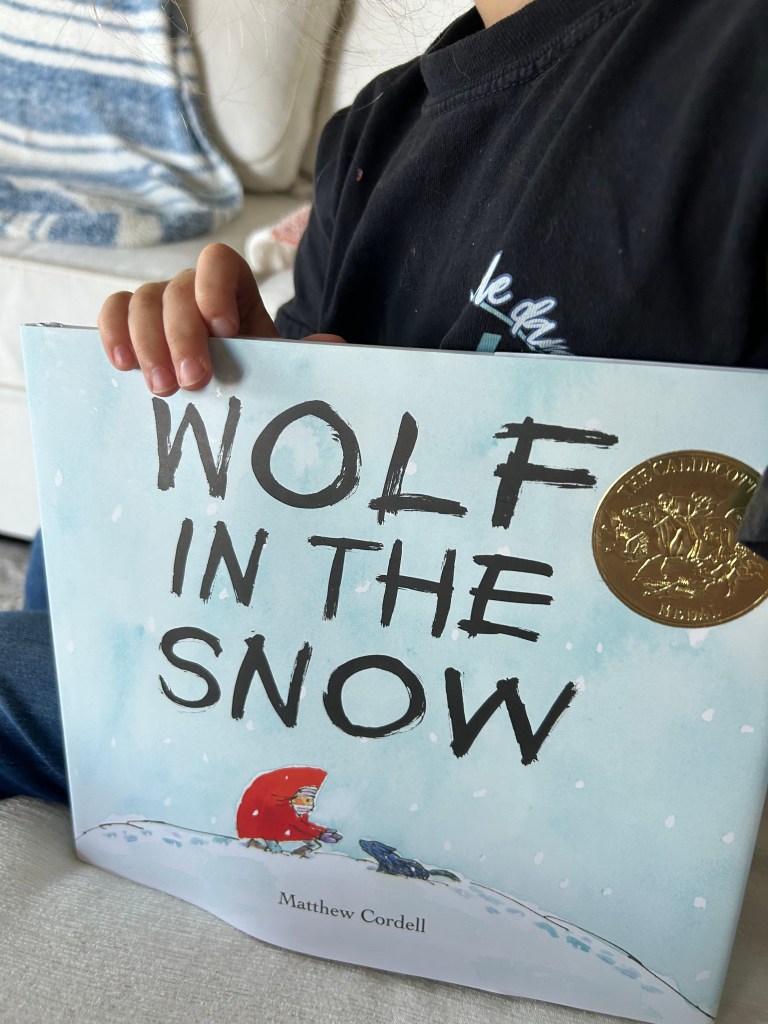
    So, what better way to capture both of her interests than in a picture book titled Wolf in the Snow ?

    SUMMARY
    Wolf in the Snow recounts the adventure of a young girl who encounters a lost wolf pup during a swirling snowstorm.
    The young girl comes upon the wolf pup on her way home from school. The drifting snow makes travel difficult, but the young girl carries the wolf pup even as the snow accumulates. The young girl is determined but the growing mounds of snow make travel difficult. Travel is also difficult for the wolfpack that is hunting for their lost pup. Eventually, the wolfpack and the young girl come face to face…and the tension is real!
    Of course, the story brings to mind the fairy tales like Little Red Riding Hood (EX: the girl wears a red coat, the girl is on her way to a house).
    The ending, however, is not Grimm Brothers gruesome, but wholly satisfying to wolf lovers of all ages.

    AUDIENCE:
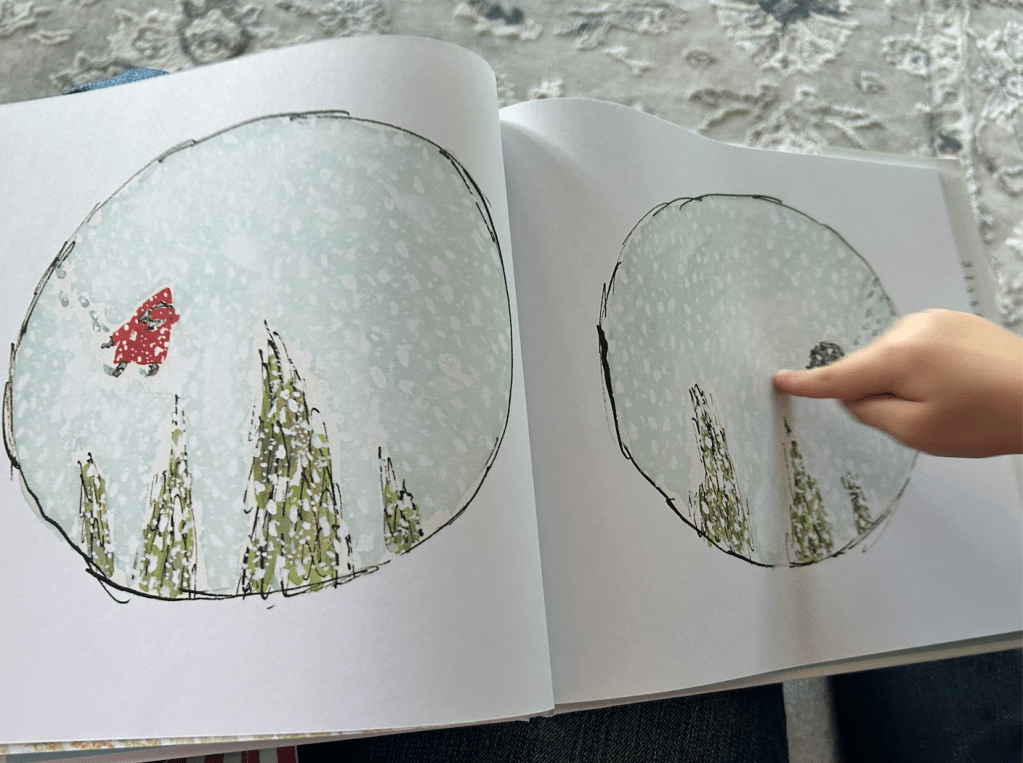
    Wolf in the Snow is an almost totally wordless picture book, ideal for readers of all ages (2 years and up). As the text is in the pictures, there are multiple ways readers may choose to “tell” this story.
    There are children who will want to linger over the details embedded on each page. And for toddlers who may have a short attention span, this book can be a fast read.
    Note: There is no dialogue, but be prepared to give a few “howls” or “barks”.

    AUTHOR/ILLUSTRATOR:
    Wolf in the Snow was released in 2017 by author/illustrator Matthew Cordell. The book was favorably received by critics and was awarded the 2017 Boston Globe-Horn Book honor award and the 2018 Caldecott Medal for illustrations.

    All of the pages have illustrations that feature the falling snow. The lightly falling flakes at the beginning soon give way to swirling whiteout conditions.
    This is very dramatic snow!

    Cordell has written and illustrated other picture books, including Trouble Gum, King Alice, Another Brother, and Hello! Hello!

    READING OPPORTUNITIES:
    A word of caution when choosing a wordless picture book for a three-year old. There will be MANY questions. most beginning with “WHY?” For example:

    • “Why does the girl go to school in the woods?”
    • “Why is she walking by herself?”
    • “Why is the wolf cub alone?”
    • “Why is she tired?”
    • “Why does the wolf pack howl?”

    All good questions.
    Wolf in the Snow answers “why” and more.