“But everything in the ocean IS wet,” counters Sloane.
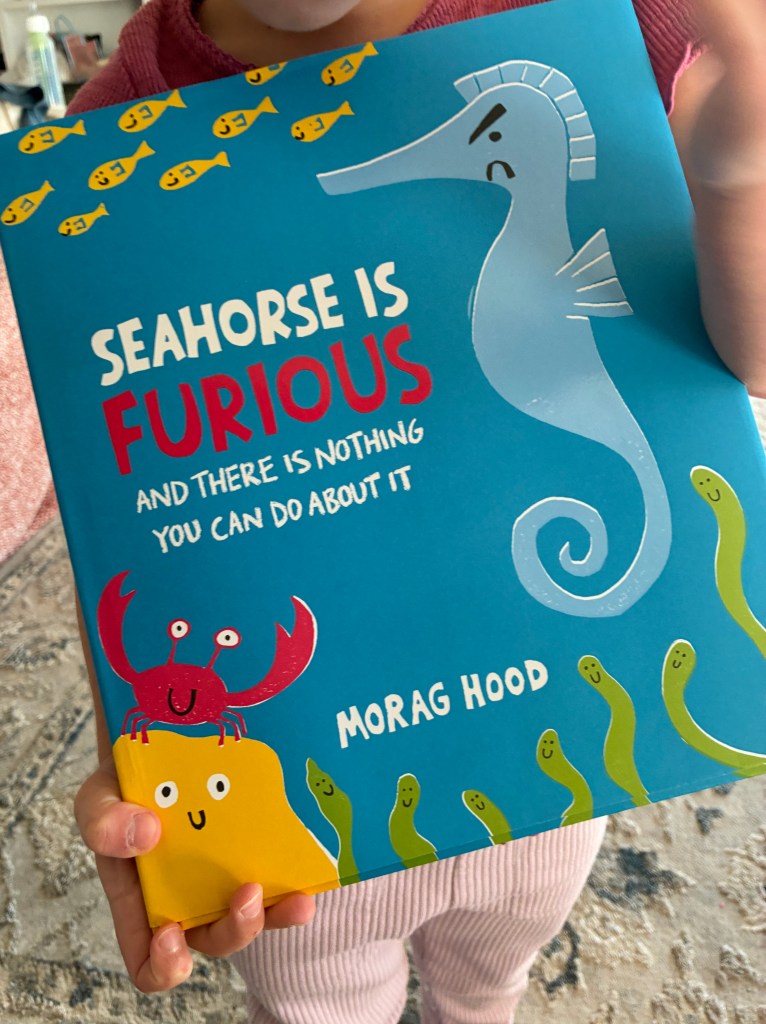
We are reading “Seahorse Is Furious: (And There Is Nothing You Can Do About It)” by Morag Hood, and Seahorse is FURIOUS! He woke up wrong, stubbed his tail, and gotten tangled in the (ridiculous!) seaweeds. Now he complains that:
His breakfast is wet.
His tail is wet.
His eyes are wet.
Everything is wet!
While Sloane is sympathetic, she is also learning to question the thinking of this particular character.
“His breakfast is always wet,” she notes patiently, “’cause he lives in the ocean.”
Summary
There is high drama in the ocean.
Today, Seahorse is grumpy.
More than Grumpy.
Seahorse is FURIOUS!
Nothing is going to help, but that does not stop an octopus and his other ocean friends. They will try many different things to make Seahorse happy…including perfectly portioned sandwich slices, served on a beautiful green plate.
Author/Illustrator
Morag Hood is an author/illustrator of at least a dozen books for young children. She has won awards from the United Kingdom Literacy Association (UKLA) for her books Colin and Lee, Carrot and Pea, and I am Bat. She has also authored three books in the Sophie Johnson series.
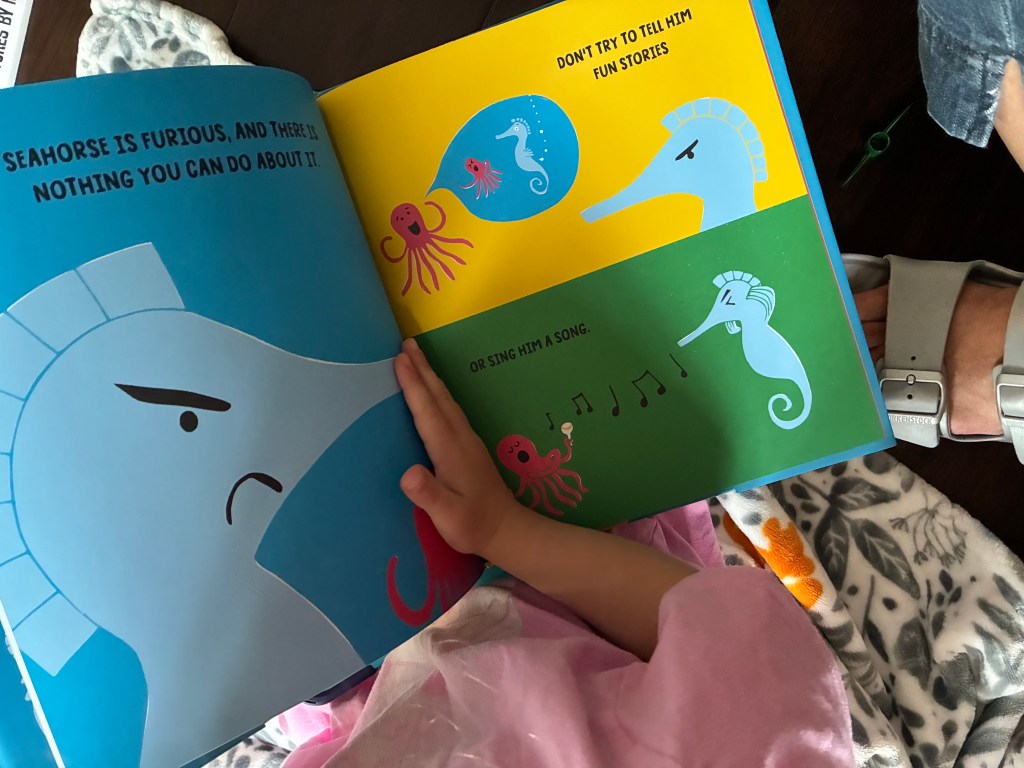
Seahorse is Furious is an example of her artistic style. The primary colored illustrations float against a sea blue background. The seaweeds hugging Seahorse resemble undersea Matisse cut-outs. Octopus wears a sweet smile on domed head. Furious Seahorse uni-brow is knit in a permanent scowl.
The text is in capital letters, with dramatic emphasis created in a larger font.
Hood combines her simple drawings with a direct message; you cannot be furious forever when your friends are determined to help.
Audience:
The book is easy to read aloud and ideal for children ages 3-7.
They understand big feelings and how hard it can be to be understood by others when those big feelings of frustration or anger or sadness become overwhelming.
Additional Information
There is plenty to smile about in Seahorse is Furious. Readers will find humor in Seahorse’s expressions and his dramatic crying.
But there is a sophisticated kind of oppositional thinking as well. Readers do not always have to agree with a character. There is space in the story for reader interaction. A child can acknowledge Seahorse’s feelings while at the same time oppose his arguments to remain furious.
This was most evident when Seahorse declared that “Hugs don’t help.”
Meeting that challenge, Sloane softly responded,”Yes, they do.”
She understood his feelings.
She also understood the solution.

